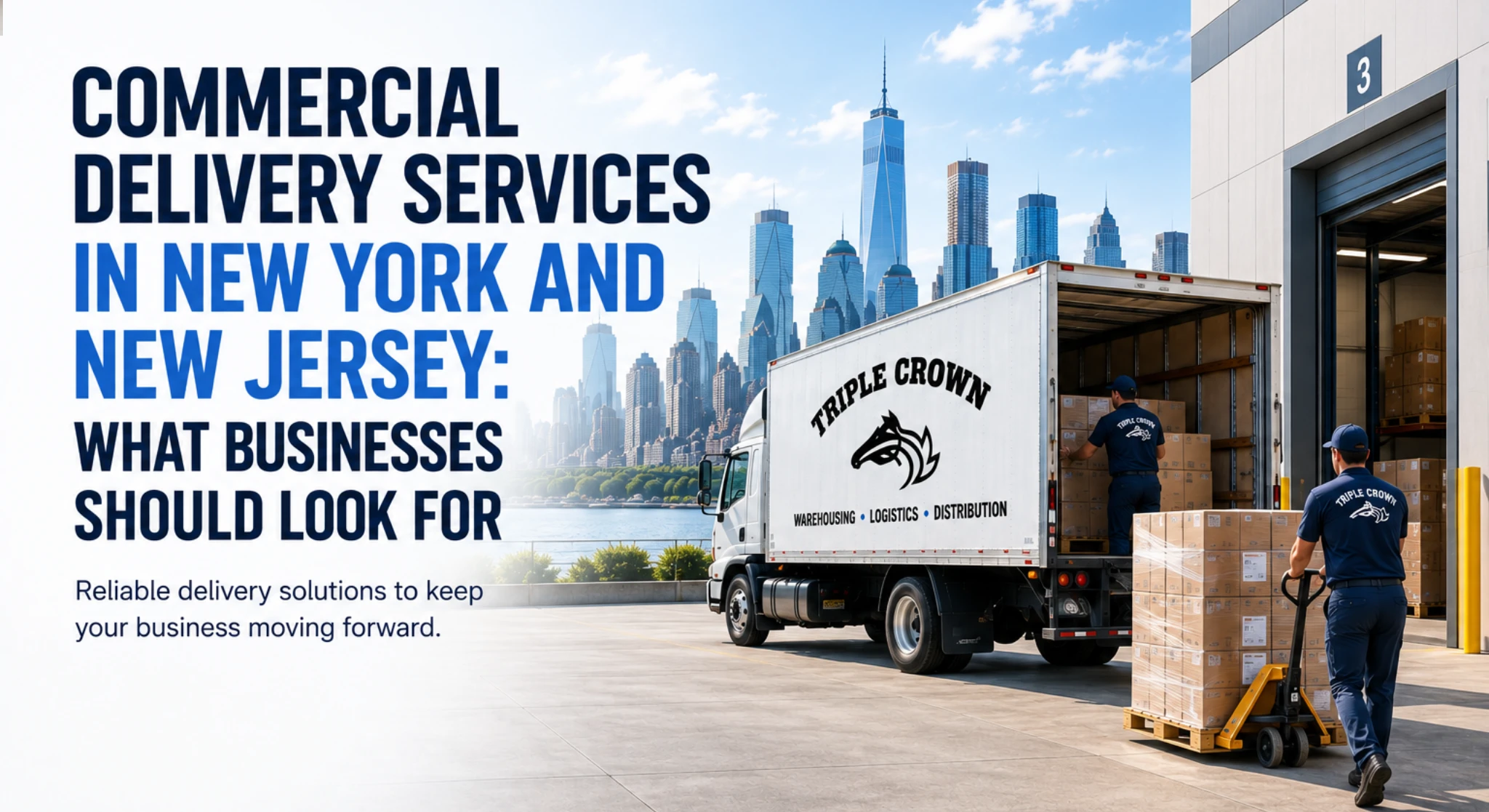
Getting products from a warehouse to their final destination may sound straightforward, but commercial delivery becomes more complex as order volume, customer expectations, and delivery requirements grow.
Businesses may need scheduled deliveries to retailers, offices, job sites, commercial facilities, or other business locations. They may also need a delivery partner capable of handling larger shipments that do not fit the traditional parcel model.
For businesses operating in New York and New Jersey, choosing the right commercial delivery provider can help improve reliability, simplify logistics, and provide customers with a more consistent delivery experience.
Commercial Delivery Is Different From Standard Parcel Shipping
Parcel carriers work well for many small packages.
But not every business shipment fits neatly into a box moving through a national carrier network.
Commercial delivery may be better suited for:
- Larger or bulk shipments
- Palletized goods
- Furniture and equipment
- Multiple-item deliveries
- Business-to-business orders
- Scheduled deliveries
- Products requiring additional handling
The right solution depends on what you’re delivering, where it needs to go, and what needs to happen when it arrives.
1. Look for Experience With B2B Deliveries
Delivering to a commercial location can involve more coordination than delivering a package to a residence.
Receiving hours may be limited. Building access may need to be arranged. Someone may need to be available to accept the shipment.
A commercial delivery provider should understand these requirements and be prepared to coordinate accordingly.
For businesses regularly shipping to other businesses, this experience can help reduce missed deliveries and unnecessary delays.
2. Make Sure the Service Area Matches Your Customers
Before selecting a delivery provider, look closely at where your customers are located.
A provider with experience throughout your primary market can help simplify transportation planning and create more consistent service.
Triple Crown’s commercial moving and delivery services are focused within New York and New Jersey, making regional service particularly relevant for businesses with customers, facilities, or distribution points across these two states.
3. Consider the Type of Products You’re Delivering
Not all commercial products should be handled the same way.
A pallet of packaged inventory has different transportation requirements from furniture, equipment, or other large commercial items.
Before choosing a provider, discuss:
- Product dimensions and weight
- Shipment volume
- Packaging
- Handling requirements
- Pickup requirements
- Delivery location
- Frequency of deliveries
Providing this information upfront helps determine whether a delivery provider is suited to the work.
4. Ask About Scheduled and Recurring Deliveries
Some businesses need occasional transportation.
Others have products moving every week or even every day.
If deliveries are recurring, consistency becomes especially important.
Businesses should determine whether a provider can support their required schedule and whether the service can adapt when order volume changes.
A reliable recurring delivery relationship can also reduce the time your team spends arranging transportation shipment by shipment.
5. Communication Matters When Something Changes
Commercial deliveries don’t always go exactly according to plan.
Receiving schedules change. Customers request different delivery times. Access issues arise. Shipments may need to be coordinated with several people.
This makes communication an important part of the service.
Your team should know who to contact when a delivery changes and be able to get clear information about what happens next.
6. Consider Whether You Need Warehousing Too
For some businesses, transportation is only one part of the problem.
Inventory may also need to be received, stored, organized, and prepared before delivery.
Working with a provider that can support both warehousing and commercial delivery can simplify the process by reducing the number of companies involved in moving inventory.
Instead of coordinating one company to store products and another to move them, businesses may be able to create a more connected flow from:
Receiving → Storage → Staging → Delivery
7. Look Beyond the Lowest Delivery Rate
Price matters, but commercial transportation should not be evaluated on price alone.
A low delivery rate provides little value if shipments routinely arrive late, communication is difficult, or the provider cannot accommodate your operational requirements.
Consider the broader impact of the service on:
- Your staff
- Your customers
- Delivery reliability
- Operational efficiency
- Time spent coordinating shipments
The right provider should reduce logistics friction rather than create more of it.
Questions to Ask a Commercial Delivery Provider
Before choosing a company, ask:
- What types of commercial products do you typically deliver?
- Do you handle B2B deliveries?
- Which areas of New York and New Jersey do you serve?
- Can you accommodate recurring deliveries?
- Can you handle larger or bulk shipments?
- How are deliveries scheduled?
- Who do we contact if something changes?
- Can you also provide warehousing if needed?
These questions help determine whether a provider fits your actual operation rather than simply offering transportation.
When Warehousing and Delivery Work Together
For businesses holding inventory before it reaches customers, warehousing and delivery should not operate as completely separate processes.
A coordinated operation can allow inventory to be received, stored, prepared, and dispatched from one location.
This can be particularly useful for companies that do not want to operate their own warehouse and transportation infrastructure.
Businesses evaluating their broader logistics operation may also want to review how to choose the right warehousing partner.
How Triple Crown Warehouse Supports Commercial Delivery
Triple Crown Warehouse provides commercial delivery, warehousing, moving, and logistics support for businesses throughout New York and New Jersey.
For businesses that need products moved between warehouses, commercial facilities, customers, or other business locations, our team can help coordinate transportation as part of a broader logistics solution.
When warehousing is also required, inventory can be stored and prepared for delivery without businesses having to coordinate multiple unrelated providers.
Final Thought
Commercial delivery is ultimately about reliability.
Your products need to reach the right location at the right time without creating unnecessary work for your team or your customers.
Choosing a provider based on service area, product capabilities, scheduling, communication, and warehousing support can help businesses build a more dependable delivery operation across New York and New Jersey.
Need Commercial Delivery in New York or New Jersey?
Speak with our team about commercial delivery, warehousing, and logistics support for your business.