Don’t Just Pick the Closest Warehouse. Pick the Right One.
Finding warehouse space in New York isn’t the hard part. There are hundreds of options across Long Island, New Jersey, and the greater metro area.
The hard part is finding a partner you can actually trust with your inventory, your timeline, and your bottom line.
Get it wrong and you’re dealing with lost shipments, surprise fees, and a vendor who doesn’t pick up the phone. Get it right and your supply chain practically runs itself.
This checklist walks you through exactly what to look for — so you don’t learn the hard way.
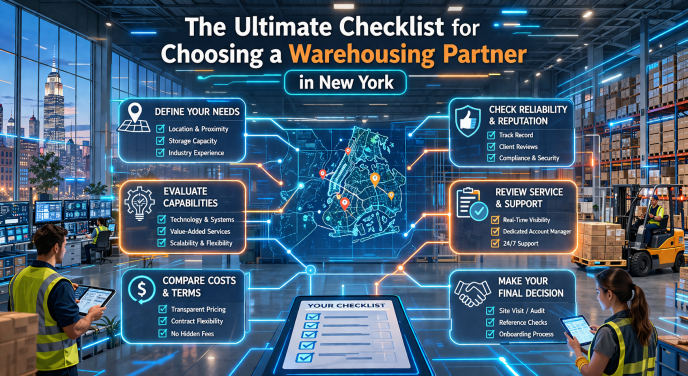
The Checklist: What to Look for in a New York Warehousing Partner
1. Location and Access to Major Ports and Highways
In New York, location is everything. You want a warehouse that sits close to the Port of New York and New Jersey, major interstates, and your key delivery zones.
Ask yourself:
- How far is the facility from the port?
- Can trucks easily access the building?
- Is it close enough to your customers for fast final-mile delivery?
A warehouse that’s 20 minutes from the port will always outperform one that’s two hours away — no matter how nice the facility looks.
Pro tip: Warehouses near Hauppauge, NY or the I-495 corridor give you quick access to both the port and the entire tri-state area.
2. Services Offered — Not Just Storage
A lot of warehouses will happily take your money to store your pallets. But what happens when you need more?
Look for a partner that offers:
- Receiving and inventory management
- Pick-and-pack fulfillment
- Distribution and trucking
- Free trade zone warehousing (more on this below)
- Record storage
- Cross-docking
The more services under one roof, the fewer vendors you have to manage. That’s less confusion, fewer handoffs, and less room for things to go wrong.
3. Free Trade Zone Warehousing Capabilities
If you import goods from overseas, this one could save you a serious amount of money.
Free trade zone warehousing lets you store imported goods in a federally designated area without paying customs duties upfront. You only pay duties when the goods actually leave the zone and enter U.S. commerce. If you re-export the goods, you may not owe duties at all.
For importers, this can mean:
- Better cash flow (you’re not paying duties on inventory you haven’t sold yet)
- Fewer delays at customs
- More flexibility on how and when goods enter the market
Not every warehouse in New York is authorized to operate as a free trade zone. Make sure to ask specifically whether a facility is FTZ-approved and whether they have experience managing FTZ compliance.
4. Facility Size, Layout, and Capacity
Square footage matters — but so does how the space is set up.
Check for:
- Ceiling height — High ceilings mean more vertical storage and better racking options
- Loading docks — How many? Are they equipped for different truck sizes?
- Climate control — Do you store anything temperature-sensitive?
- Overflow capacity — Can the facility scale with you during peak seasons?
Walk the floor if you can. A well-organized warehouse tells you a lot about how a company operates.
5. Security and Safety Standards
Your inventory is valuable. Treat it that way when evaluating a facility.
At minimum, look for:
- 24/7 surveillance cameras
- Gated or secured access
- On-site staff or security personnel
- Fire suppression systems
- Clear protocols for damaged or lost goods
Ask directly: What happens if something is damaged or goes missing? How they answer that question tells you everything.
6. Technology and Inventory Visibility
You shouldn’t have to call someone just to find out if your shipment arrived.
A modern warehousing partner should give you:
- A warehouse management system (WMS)
- Real-time inventory tracking
- Reporting and shipment visibility
- Easy communication when something changes
If they’re still running everything on spreadsheets and phone calls, that’s a red flag.
7. Pricing Transparency — No Hidden Fees
Warehousing quotes can look cheap until you see the invoice.
Before you sign anything, ask for a full breakdown of:
- Monthly storage rates (per pallet, per square foot, or flat fee?)
- Receiving and handling fees
- Pick-and-pack charges
- Fuel surcharges for delivery
- Fees for after-hours access or special requests
A good partner will walk you through pricing without hesitation. If they’re vague or slow to answer, expect surprises later.
8. Experience in Your Industry
Not all warehousing operations are the same. A facility that handles construction equipment operates very differently from one that stores retail merchandise or pharmaceutical supplies.
Ask about:
- Industries they currently serve
- How long they’ve been in business
- Whether they’ve handled inventory similar to yours
Experience matters. A warehouse team that knows your product category will make fewer mistakes and catch problems before they become expensive.
9. References and Reputation
Don’t just take their word for it. Look them up.
- Check Google reviews
- Ask for two or three client references
- Look at their social media and website — do they look like an active, professional operation?
A company with a solid reputation in the New York logistics community has earned it. And one with consistent complaints? That’s a pattern, not a fluke.
10. Contract Flexibility
Business changes. Your warehousing agreement should be able to change with it.
Watch out for:
- Long-term contracts with no exit clause
- Auto-renewal terms buried in the fine print
- Penalties for scaling down during slow seasons
Look for month-to-month options or short-term agreements that give you room to grow, shrink, or pivot as needed.
Why New York Businesses Trust Triple Crown Warehouse
Triple Crown Warehouse is based in Hauppauge, NY — right in the heart of Long Island’s logistics corridor. We offer free trade zone warehousing, record storage, trucking, final-mile delivery, and full logistics coordination under one roof.
We work with importers, retailers, e-commerce brands, and institutions across the tri-state area. Our team knows New York logistics inside and out — and we’re straightforward about pricing, services, and what you can expect from us.
If you’re ready to find a warehousing partner you can count on, contact us today or call (631) 348-4994.
Frequently Asked Questions
What should I look for when choosing a warehousing partner in New York?
Look for a facility with a strong location near major ports and highways, transparent pricing, modern inventory tracking, and a range of services beyond basic storage. Security, industry experience, and contract flexibility are also key factors. If you import goods, ask whether the facility offers free trade zone warehousing, which can reduce customs costs and improve your cash flow.
What is free trade zone warehousing and how does it benefit importers?
Free trade zone warehousing allows businesses to store imported goods in a federally designated zone without paying U.S. customs duties upfront. Duties are only owed when goods leave the zone and enter domestic commerce. This gives importers better control over cash flow, reduces delays at customs, and adds flexibility for re-exporting goods without paying duties at all.
How close should a warehouse be to the Port of New York and New Jersey?
Ideally, your warehouse should be within 30 to 60 minutes of the port to keep transportation costs low and turnaround times fast. Facilities in areas like Hauppauge, NY or northern New Jersey offer strong access to the port while also covering the tri-state distribution area efficiently.
What is the difference between a standard warehouse and an FTZ warehouse in New York?
A standard warehouse stores goods that have already cleared U.S. customs and entered domestic commerce. An FTZ warehouse — or free trade zone warehouse — is a federally authorized facility where imported goods can be stored, processed, or re-exported before customs duties are assessed. FTZ warehouses are ideal for importers who want to manage duty costs strategically and avoid tying up capital in unpaid inventory.
How do I avoid hidden fees when working with a New York warehousing company?
Always ask for a complete, itemized pricing breakdown before signing a contract. Request specific rates for storage, receiving, handling, pick-and-pack, fuel surcharges, and any special services. A trustworthy warehousing partner will give you clear answers upfront. If a company is vague about fees or delays in sharing a written quote, that’s a sign to look elsewhere.
Published by Triple Crown Warehouse | Hauppauge, NY | triplecrownwarehouse.com