Starting an import business is exciting—but it can also be overwhelming. Between navigating customs regulations, managing suppliers overseas, and controlling costs, new importers face a steep learning curve. One decision that can significantly impact your profitability from day one is choosing the right warehousing solution.
If you’re importing products into the United States, you’ve probably heard about free trade zone warehousing. But what exactly is it? How does it work? And most importantly, is it right for your new import business?
This complete guide breaks down everything first-time importers need to know about free trade zone warehousing, from the basics to getting started, helping you make informed decisions that set your business up for long-term success.
What Is Free Trade Zone Warehousing?
Let’s start with the fundamentals. A free trade zone warehouse (also called an FTZ warehouse or foreign trade zone warehouse) is a secure facility located within a specially designated area in the United States. These zones are under U.S. Customs and Border Protection supervision but are legally considered outside U.S. customs territory for duty purposes.
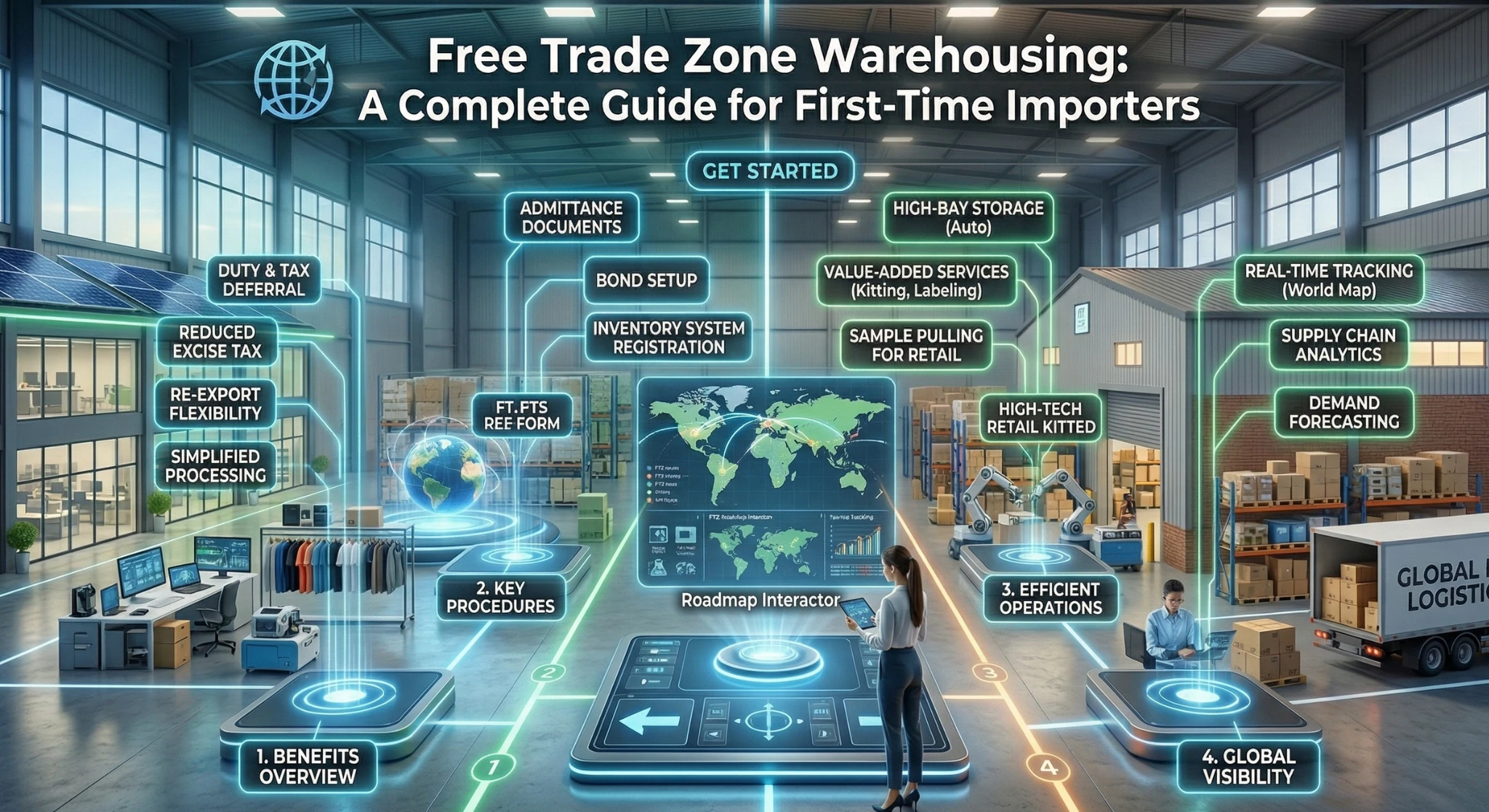
What does this mean in practical terms? When you store imported goods in a free trade zone warehouse, you don’t have to pay U.S. customs duties immediately. Instead, duties are deferred until the goods officially enter U.S. commerce—typically when they’re sold and shipped to customers.
According to the U.S. Customs and Border Protection, there are nearly 200 active Foreign-Trade Zones across the United States, serving thousands of companies from small startups to Fortune 500 corporations.
How Free Trade Zone Warehousing Works: The Basics
Understanding the fundamental process helps demystify FTZ warehousing:
Step 1: Your Goods Arrive in the U.S.
Your shipment arrives at a U.S. port (sea or air). Instead of going through standard customs clearance where duties would be paid immediately, the goods are transported directly to an FTZ warehouse.
Step 2: Admission to the FTZ
Your FTZ warehouse operator files the necessary paperwork with U.S. Customs to “admit” your goods into the foreign trade zone. At this point, your inventory enters duty-deferred status—no customs duties are owed yet.
Step 3: Storage and Processing
Your products sit in the FTZ warehouse in this duty-deferred status. During this time, you can:
- Store inventory as long as needed
- Inspect products for quality
- Repackage or relabel items
- Combine products into kits
- Perform light assembly or manufacturing
Step 4: Entering U.S. Commerce
When you sell products and need to ship them to U.S. customers, those specific items are “withdrawn” from the FTZ and officially enter U.S. commerce. This is when customs duties are calculated and paid—but only on the goods actually being sold, not your entire inventory.
Alternative: Re-Export
If products don’t sell or if you’re shipping to international customers, you can re-export items directly from the FTZ without ever paying U.S. customs duties on them.
This basic flow creates significant financial and operational advantages, which we’ll explore next.
Key Benefits for First-Time Importers
As a new importer, you’re likely operating with limited capital and trying to minimize risk. Free trade zone warehousing addresses both concerns:
1. Improved Cash Flow
Traditional warehousing requires paying customs duties when goods arrive—before you’ve made a single sale. For a new business importing $100,000 worth of products with a 5% duty rate, that’s $5,000 tied up in duty payments immediately.
In an FTZ warehouse, you only pay duties as products sell. This keeps your cash available for critical startup needs like marketing, inventory replenishment, or covering operating expenses.
2. Reduced Risk on New Products
As a first-time importer, you’re testing the market. What if products don’t sell as well as expected? In a traditional warehouse, you’ve already paid duties on inventory that’s sitting unsold.
In an FTZ warehouse, unsuccessful products can be returned to your supplier or re-exported without ever incurring U.S. customs duties. This dramatically reduces your financial risk when testing new products or entering new markets.
3. Flexibility for International Sales
Many new importers sell both domestically and internationally. With FTZ warehousing, you can serve both markets from one facility:
- Products sold in the U.S. pay duties when shipped
- Products shipped internationally never incur U.S. duties
This unified inventory approach is far simpler than maintaining separate domestic and international stock.
4. Duty Savings on Damaged or Defective Goods
Quality issues happen, especially when working with new suppliers. Products damaged in transit or found to be defective can be returned or destroyed while in FTZ status—meaning you never pay duties on merchandise you can’t sell.
5. Value-Added Services Without Duty Impact
Need to add your brand labels? Repackage for Amazon FBA requirements? Create promotional bundles? All these activities can happen in the FTZ before duties are paid, and in some cases, can actually reduce your total duty obligation.
As detailed in our guide on FTZ warehousing benefits, these advantages compound over time as your business grows.
Common Misconceptions About FTZ Warehousing
Before we go further, let’s clear up some myths that often confuse first-time importers:
Myth 1: “FTZ is only for large companies”
Reality: FTZ warehousing benefits businesses of all sizes. Even small importers bringing in one or two containers monthly can see meaningful savings.
Myth 2: “The paperwork is too complicated”
Reality: Your FTZ warehouse operator handles the bulk of FTZ-specific documentation. From your perspective, it’s often simpler than traditional importing.
Myth 3: “It costs much more than regular warehousing”
Reality: While FTZ warehouse rates might be slightly higher, the duty deferral benefits typically far outweigh any difference in storage costs.
Myth 4: “I’ll get audited constantly by customs”
Reality: FTZ facilities operate under CBP supervision, but this doesn’t mean constant audits of your business. Your warehouse operator manages compliance.
Myth 5: “I need to understand all the customs regulations”
Reality: You should understand the basics, but experienced FTZ warehouse partners guide you through the process and handle the technical compliance.
Is FTZ Warehousing Right for Your Import Business?
Not every import business needs FTZ warehousing, but it makes particular sense if you answer “yes” to several of these questions:
About your products:
- Do your products have duty rates of 3% or higher?
- Are you importing products worth $50,000+ annually?
- Do you import items with uncertain market demand?
About your business model:
- Do you test multiple products to see what sells?
- Do you sell to both U.S. and international customers?
- Is cash flow tight in your startup phase?
- Do you carry inventory for more than 30 days before selling?
About your operations:
- Would you benefit from repackaging or relabeling products?
- Do you sometimes return products to suppliers?
- Are you working with new suppliers where quality might be inconsistent?
The more “yes” answers, the stronger the case for FTZ warehousing from the start.
Getting Started: Step-by-Step Guide for First-Time Importers
Ready to explore FTZ warehousing? Here’s your roadmap:
Step 1: Calculate Your Potential Savings
Before making decisions, run the numbers:
- Estimate your annual import value
- Determine average duty rates on your products (check the Harmonized Tariff Schedule)
- Calculate how long inventory typically sits before selling
- Estimate what percentage of sales might be international
Use these figures to project cash flow benefits. Even rough estimates help you understand potential value.
Step 2: Find FTZ Warehouse Partners
Look for warehouses that:
- Are located conveniently near your port of entry or target markets
- Have experience with businesses similar to yours
- Offer services you need (storage, fulfillment, value-added services)
- Provide modern inventory management systems
- Have strong references from current clients
Our article on choosing the right FTZ warehouse provides detailed selection criteria.
Step 3: Understand the Fee Structure
Get clear quotes that include:
- Monthly storage rates (per pallet or per square foot)
- Receiving and handling fees
- FTZ administrative charges
- Order fulfillment costs if applicable
- Any minimum monthly commitments
Compare total costs to traditional warehousing while factoring in duty deferral benefits.
Step 4: Plan Your First Shipment
Work with your FTZ warehouse partner to:
- Arrange transportation from port to FTZ facility
- Complete necessary FTZ admission paperwork
- Set up your account in their warehouse management system
- Establish communication protocols and reporting preferences
Your warehouse should guide you through this entire process.
Step 5: Coordinate with Your Customs Broker
Inform your customs broker that you’ll be using FTZ warehousing. They’ll need to:
- File different entry types for FTZ-destined shipments
- Coordinate with your warehouse on documentation
- Advise on duty implications of different product classifications
Many FTZ warehouses work closely with customs brokers and can facilitate this coordination.
Step 6: Set Up Systems and Processes
Establish clear procedures for:
- How and when inventory will be withdrawn from the FTZ
- Who approves duty payments
- How returns and damaged goods are handled
- Communication with the warehouse for orders and inventory questions
Clear processes from the start prevent confusion later.
Common Mistakes First-Time Importers Make (And How to Avoid Them)
Learn from others’ experiences. Here are frequent pitfalls and how to sidestep them:
Mistake 1: Not Planning for Duty Payment Timing
Some new importers forget duties are deferred, not eliminated. Budget for duty payments as products sell and include them in your cost of goods sold.
Mistake 2: Choosing Location Over Capabilities
Selecting a warehouse purely on proximity without considering services or expertise often backfires. Prioritize overall value and capabilities.
Mistake 3: Inadequate Record Keeping
Not tracking duty-deferred versus duty-paid inventory creates compliance issues. Use your warehouse’s management system properly and maintain good records.
Mistake 4: Overlooking Value-Added Services
Missing opportunities for FTZ-based processing or relabeling means leaving money on the table. Discuss your product flow with your warehouse partner.
Mistake 5: Not Understanding Duty Rates
Research duty rates before committing to FTZ warehousing. The U.S. International Trade Commission provides tariff information for informed decisions.
Mistake 6: Waiting Too Long to Switch
Starting with traditional warehousing “to keep things simple” often means months of lost savings. Evaluate FTZ options from the start with an experienced partner.
What to Expect in Your First 90 Days
Here’s a realistic timeline for first-time importers starting with FTZ warehousing:
Days 1-30: Setup and Learning
- Complete warehouse account setup
- Learn the warehouse management system
- Receive and admit your first shipment to the FTZ
- Work through any initial questions or confusion
- Establish communication rhythms with warehouse team
Days 31-60: Process Refinement
- Process your first orders from FTZ inventory
- Handle your first duty payment on withdrawn goods
- Refine procedures based on early experience
- Identify any additional services you need
- Build confidence in the FTZ process
Days 61-90: Optimization
- Evaluate cost savings versus projections
- Identify opportunities for improvement
- Expand use of value-added services
- Establish predictable routines
- Plan for growth and increased volumes
Most first-time importers report that FTZ warehousing feels completely routine by the end of this period.
Resources for Continued Learning
Continue educating yourself as you grow:
- U.S. Customs and Border Protection FTZ program information
- U.S. International Trade Commission for tariff research
- National Association of Foreign-Trade Zones (NAFTZ)
Your FTZ warehouse should also be a knowledge resource, providing ongoing guidance as your needs evolve.
Taking Your First Step
Starting an import business involves many decisions, but choosing the right warehousing solution early can set you up for long-term success. For most first-time importers bringing in significant volumes of dutiable goods, free trade zone warehousing offers compelling advantages: better cash flow, reduced risk, operational flexibility, and significant cost savings.
The key is working with an experienced FTZ warehouse partner who understands the unique needs of startup importers and can guide you through the process. With the right partner, FTZ warehousing is straightforward to implement and immediately beneficial.
Ready to explore whether free trade zone warehousing is right for your import business? Contact our team at (631) 348-4994 to discuss your specific situation. We specialize in helping first-time importers understand their options and get started with FTZ warehousing. Our comprehensive services and experienced team make the transition smooth and beneficial from day one.
About Triple Crown Warehouse: We’ve helped hundreds of importers—from first-time entrepreneurs to established businesses—leverage the benefits of FTZ warehousing. Our 110,000 sq. ft. FTZ-certified facility combines Foreign Trade Zone advantages with the guidance and support new importers need to succeed.