Choosing the right warehousing solution is one of the most important decisions you’ll make for your import business. Get it right, and you’ll optimize costs, improve cash flow, and position yourself for growth. Get it wrong, and you could be leaving thousands of dollars on the table every month.
For businesses that import products into the United States, the choice often comes down to two options: a free trade zone warehouse or a traditional warehouse. While both provide storage and distribution services, they operate under fundamentally different models with dramatically different financial implications.
This comprehensive guide breaks down the key differences between free trade zone warehouses and traditional warehouses, helping you determine which option aligns best with your business needs, import volumes, and growth plans.
Understanding the Fundamental Difference
Before diving into detailed comparisons, let’s clarify the core distinction between these two warehousing models.
Traditional Warehouse
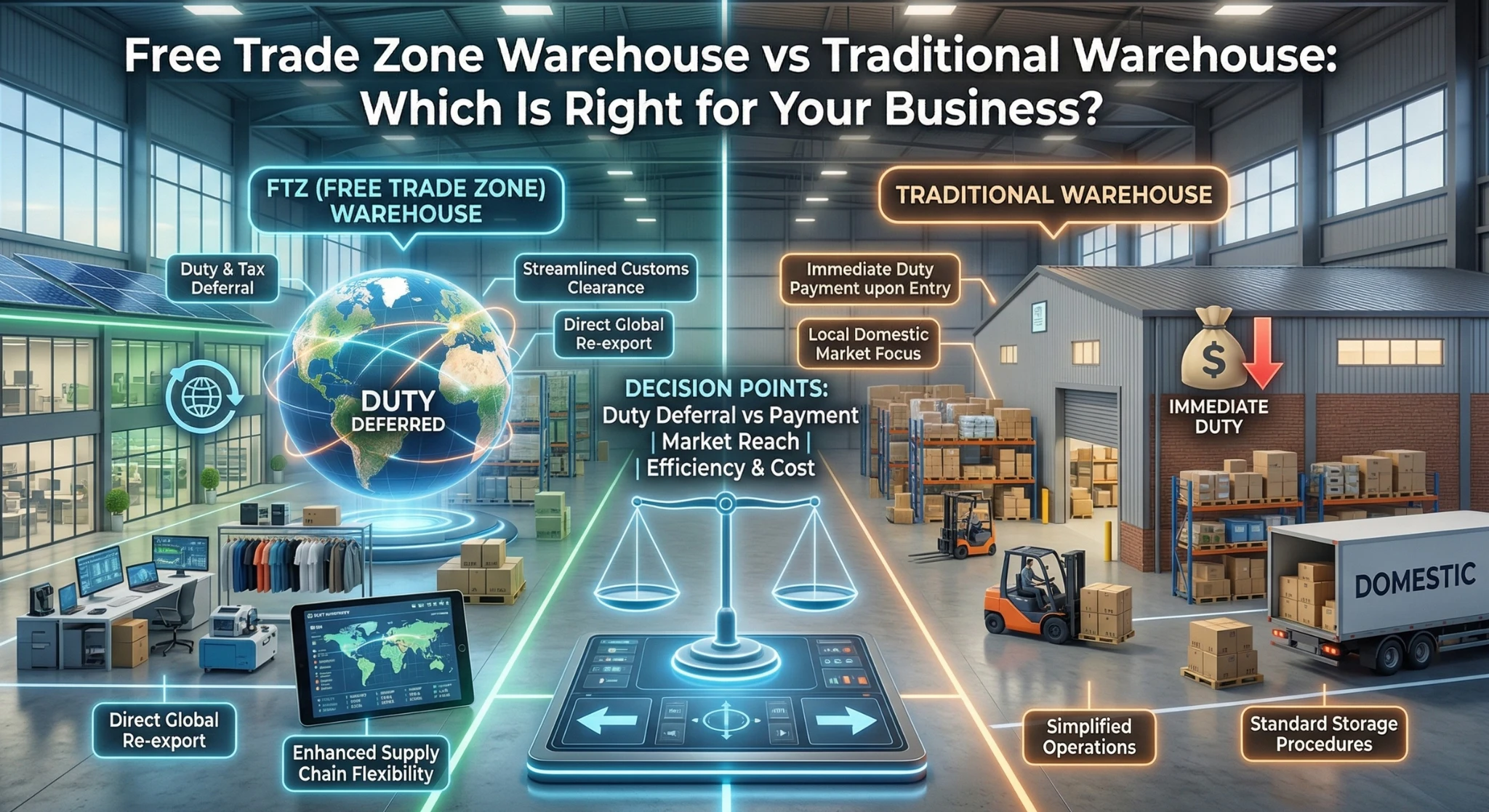
A traditional warehouse is a standard storage facility where imported goods are stored after clearing U.S. Customs. By the time your products reach a traditional warehouse, you’ve already paid all applicable customs duties, taxes, and fees. The warehouse simply provides storage space and related services—there’s no special customs treatment or duty benefits.
Free Trade Zone Warehouse
A free trade zone warehouse operates within a designated Foreign-Trade Zone (FTZ), a secure area under U.S. Customs and Border Protection supervision but legally considered outside U.S. customs territory for duty purposes. Goods stored in an FTZ warehouse remain in a duty-deferred or duty-exempt status until they officially enter U.S. commerce.
According to the U.S. International Trade Commission, Foreign-Trade Zones are established to encourage U.S. companies to compete in global markets by reducing costs associated with international trade.
This fundamental difference—when duties are paid—creates a cascade of financial and operational implications that we’ll explore throughout this comparison.
Cost Comparison: Where Your Money Goes
Let’s start with what matters most to your bottom line: cost.
Duty Payment Timing
Traditional Warehouse:
- Duties paid immediately when goods arrive in the U.S.
- Payment occurs before products are sold or generate revenue
- Requires upfront capital for duty payments regardless of inventory velocity
Free Trade Zone Warehouse:
- Duties deferred until goods leave the FTZ and enter U.S. commerce
- Payment occurs only when products are actually sold
- Cash remains available for other business needs
Real-world example: A business importing $500,000 worth of goods monthly with a 5% average duty rate would need to pay $25,000 in duties upfront with a traditional warehouse. With an FTZ warehouse and 60-day average inventory turn, that $25,000 stays in working capital for two months—effectively a $50,000 cash flow improvement at any given time.
Storage and Handling Costs
Traditional Warehouse:
- Generally lower base storage rates per square foot
- Fewer regulatory requirements can mean simpler operations
- More providers available, creating competitive pricing
Free Trade Zone Warehouse:
- May have slightly higher base rates to cover FTZ compliance
- Specialized expertise and certifications required
- Fewer facilities available, though competition still exists
Important note: The difference in storage rates is typically far smaller than the cash flow benefits from duty deferral. Even a 10-20% premium on storage costs is usually offset many times over by duty payment timing benefits.
Total Landed Cost
When calculating your true costs, you need to consider the complete picture:
Traditional Warehouse total costs:
- Storage fees
- Handling charges
- Duties paid upfront (opportunity cost of tied-up capital)
- Insurance on duty-paid inventory
- Potential losses on duties paid for unsold or damaged goods
Free Trade Zone Warehouse total costs:
- Storage fees (potentially slightly higher)
- Handling charges
- FTZ administrative fees
- Duties paid only on sold goods
- No duty payment on damaged, obsolete, or re-exported items
For most importers, particularly those with significant duty obligations, the total landed cost favors FTZ warehousing despite potentially higher storage rates.
Cash Flow and Financial Implications
Cash flow can make or break a growing business. This is where the differences become most dramatic.
Working Capital Impact
Traditional Warehouse: Large portions of your working capital are locked up in prepaid duties. For a business with $2 million in annual imports at 6% duty rates, that’s $120,000 paid to customs that could otherwise fund:
- Additional inventory purchases
- Marketing and customer acquisition
- Hiring and expansion
- Emergency reserves
Free Trade Zone Warehouse: That same $120,000 in annual duties is paid gradually as products sell, keeping cash available for growth initiatives. As detailed in our guide on how FTZ warehousing cuts costs for importers, this cash flow advantage compounds over time.
Financial Reporting
Traditional Warehouse: Duties appear as expenses when paid (at import), which may not align with when products actually sell, potentially distorting profitability analysis.
Free Trade Zone Warehouse: Duties are expensed when goods enter commerce, better matching costs with revenues and providing clearer profit visibility by product line.
Seasonal Business Considerations
Traditional Warehouse: Seasonal businesses must pay duties during inventory build-up periods (when cash is tight) rather than during selling seasons (when revenue is generated).
Free Trade Zone Warehouse: Duty payments align with sales periods, dramatically improving cash flow management for businesses with seasonal demand patterns.
Operational Flexibility and Capabilities
Beyond costs, consider how each warehouse type supports your operational needs.
Inventory Management Options
Traditional Warehouse: Once duties are paid, goods must enter U.S. commerce. You can’t:
- Re-export without complex duty drawback procedures
- Return to suppliers without losing duty payments
- Scrap damaged goods without eating the duty cost
Free Trade Zone Warehouse: Goods in duty-deferred status can be:
- Re-exported duty-free
- Returned to suppliers without U.S. duty implications
- Scrapped or destroyed without duty obligations
- Held indefinitely without triggering duty payment
This flexibility is crucial for businesses testing new products or managing uncertain demand.
Value-Added Services
Traditional Warehouse: Standard services like storage, pick/pack, and shipping. Any manipulation of goods happens after duties are paid on the original configuration.
Free Trade Zone Warehouse: According to the National Association of Foreign-Trade Zones, FTZ facilities can perform extensive value-added services on duty-deferred goods:
- Inspection and quality control
- Repackaging and relabeling
- Assembly and light manufacturing
- Product testing and compliance verification
- Kitting and bundling
Importantly, these services can reduce your total duty obligation if they result in a lower-duty finished product (inverted tariff scenarios).
Multi-Channel Distribution
Traditional Warehouse: Works well for straightforward domestic distribution but offers no advantages for international sales or multiple sales channels.
Free Trade Zone Warehouse: Ideal for omnichannel operations:
- Serve domestic customers (pay duties on those sales)
- Serve international customers (no U.S. duties on re-exports)
- Manage inventory for retail, wholesale, and e-commerce from one facility
- Allocate inventory dynamically based on demand
Compliance and Administrative Considerations
Both warehouse types involve regulatory compliance, but the nature differs significantly.
Customs Compliance
Traditional Warehouse:
- Standard import documentation and customs clearance
- Duties paid at import through your customs broker
- No ongoing FTZ reporting requirements
- Simpler for businesses with limited import experience
Free Trade Zone Warehouse:
- FTZ activation and admission procedures
- Weekly inventory reporting to CBP
- Specialized documentation for goods entering commerce
- Requires FTZ expertise (typically provided by warehouse operator)
The good news: experienced FTZ warehouse operators handle the bulk of compliance requirements, minimizing your administrative burden.
Record Keeping
Traditional Warehouse: Standard inventory records, similar to any warehouse operation.
Free Trade Zone Warehouse: More detailed tracking required:
- Duty status of all inventory
- Zone admissions and removals
- Value-added activities performed
- Reconciliation of physical vs. system inventory
Modern warehouse management systems automate most of this tracking, making it largely transparent to you.
When Traditional Warehousing Makes Sense
Free trade zone warehouses offer compelling advantages, but traditional warehousing is the better choice for certain situations:
Low Duty Products
If your products have minimal duty rates (under 2-3%), the cash flow benefits of FTZ warehousing may not justify any additional complexity or cost.
Very Fast Inventory Turn
Businesses with inventory turns measured in days rather than weeks see less benefit from duty deferral since duties would be paid quickly anyway.
Domestic-Only Operations
If you manufacture or source entirely domestically with no imported components, FTZ benefits don’t apply.
Limited Import Volume
Very small importers (under $100,000 annually) may find the simplicity of traditional warehousing more appropriate, though this depends on duty rates and inventory velocity.
Need for Maximum Location Options
Traditional warehouses are more common, so you’ll have more geographic choices if location is your primary concern.
When Free Trade Zone Warehousing Makes Sense
FTZ warehousing becomes increasingly advantageous in these scenarios:
Significant Import Volumes
The more you import, the more cash flow you free up through duty deferral. Businesses importing $500,000+ annually typically see substantial benefits.
High-Duty Products
Products with duty rates above 5% create meaningful savings opportunities through both deferral and potential elimination.
Product Testing and Development
Businesses frequently testing new products benefit from the ability to re-export unsuccessful items duty-free.
International Sales
If 10%+ of your sales go to international customers, eliminating duties on those shipments creates immediate savings.
Seasonal Inventory Patterns
Seasonal businesses with long inventory build-up periods before selling seasons realize major cash flow advantages.
Assembly or Manufacturing
Businesses performing assembly or light manufacturing may benefit from inverted tariff opportunities where finished products have lower duty rates than components.
As explored in our article on FTZ warehousing benefits for growing operations, these advantages compound as your business scales.
Making Your Decision: A Framework
Here’s a practical decision-making framework:
Step 1: Calculate Your Potential Savings
Determine:
- Annual import value
- Average duty rate on your products
- Average inventory turn time
- Percentage of sales that are international
Use these figures to estimate:
- Cash flow benefit from duty deferral
- Duty elimination savings on re-exports
- Duty avoidance on damaged/unsold goods
Step 2: Assess Your Growth Plans
Consider:
- Projected import volume growth
- Plans for product line expansion
- International market development
- Seasonal fluctuations in inventory needs
Fast-growing businesses benefit more from FTZ advantages over time.
Step 3: Evaluate Operational Needs
Ask yourself:
- Do we test many new products?
- Do we need to return goods to suppliers occasionally?
- Would value-added services in the warehouse help us?
- Are we selling through multiple channels?
The more “yes” answers, the stronger the case for FTZ warehousing.
Step 4: Compare Total Costs
Get quotes from both traditional and FTZ warehouses, including:
- Monthly storage rates
- Handling fees
- Administrative charges
- Any minimum commitments
Factor in the financial benefits calculated in Step 1.
Step 5: Consider Implementation
Assess your team’s customs expertise, willingness to learn new procedures, and timeline for implementation. A knowledgeable FTZ warehouse partner significantly reduces implementation complexity.
Hybrid Approaches and Transitions
You don’t necessarily need to choose one solution forever. Some businesses start by moving only their highest-duty products to an FTZ warehouse while keeping other items in traditional storage. You can also transition gradually as you become comfortable with FTZ procedures and verify the benefits.
Getting Started with the Right Choice
The decision between a free trade zone warehouse and a traditional warehouse isn’t one-size-fits-all. It depends on your specific business model, import characteristics, and growth objectives.
For most businesses importing significant volumes of dutiable goods, FTZ warehousing delivers compelling financial and operational advantages that traditional warehousing simply can’t match. The cash flow benefits alone often justify the transition, before even considering the flexibility, risk mitigation, and strategic advantages.
However, businesses with minimal imports, very low-duty products, or extremely fast inventory turns may find traditional warehousing perfectly adequate for their needs.
The key is making an informed decision based on your actual numbers and circumstances rather than assumptions or conventional wisdom.
Ready to explore which warehousing solution is right for your business? Contact our team at (631) 348-4994 to discuss your specific situation. We can help you calculate the potential benefits of FTZ warehousing and determine whether it makes sense for your operation. Our comprehensive services support both traditional and FTZ warehousing needs, ensuring you get the solution that best fits your business.
About Triple Crown Warehouse: With 110,000 sq. ft. of FTZ-certified warehouse space and decades of logistics experience, we help businesses make informed decisions about their warehousing strategy. Whether you choose traditional or FTZ warehousing, we provide the expertise, technology, and service to support your success.