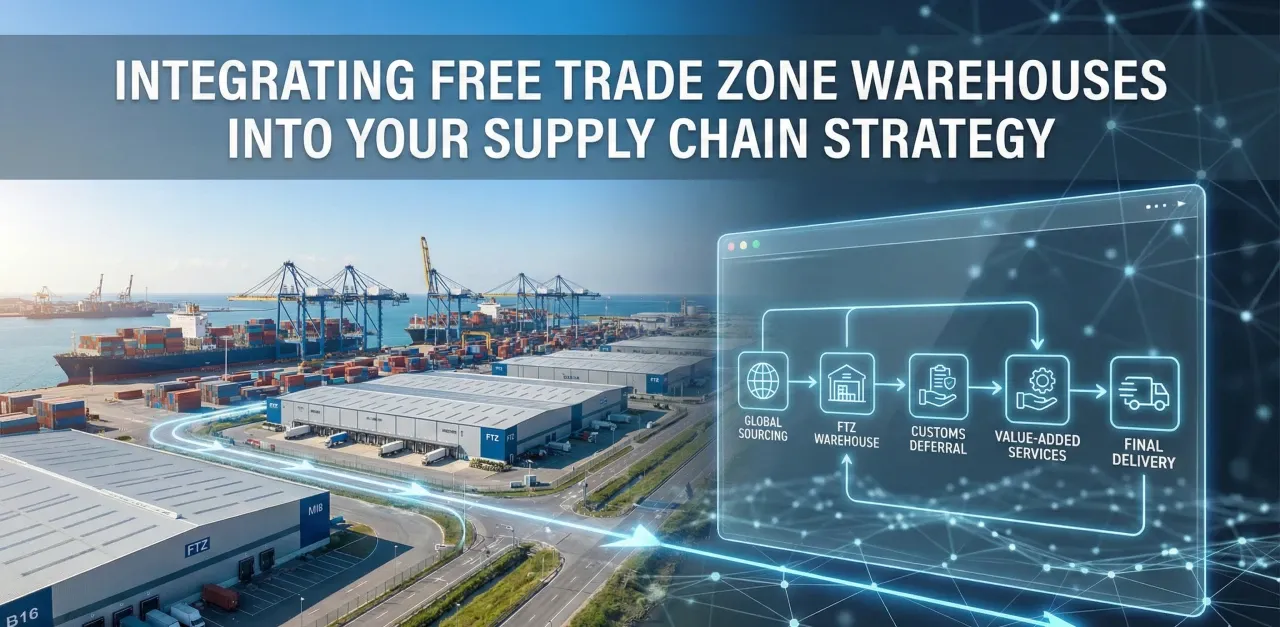
If you’re looking to optimize your supply chain and reduce costs, a free trade zone warehouse might be the missing piece in your logistics puzzle. But simply choosing an FTZ facility isn’t enough—you need to strategically integrate it into your broader supply chain operations to maximize the benefits.
This guide shows you how to successfully incorporate a free trade zone warehouse into your supply chain strategy, helping you unlock duty savings, improve cash flow, and gain competitive advantages in today’s global marketplace.
Understanding the Strategic Value of FTZ Warehouses
A free trade zone warehouse offers more than just storage space. When properly integrated into your supply chain, it becomes a powerful tool for cost reduction, inventory optimization, and market flexibility.
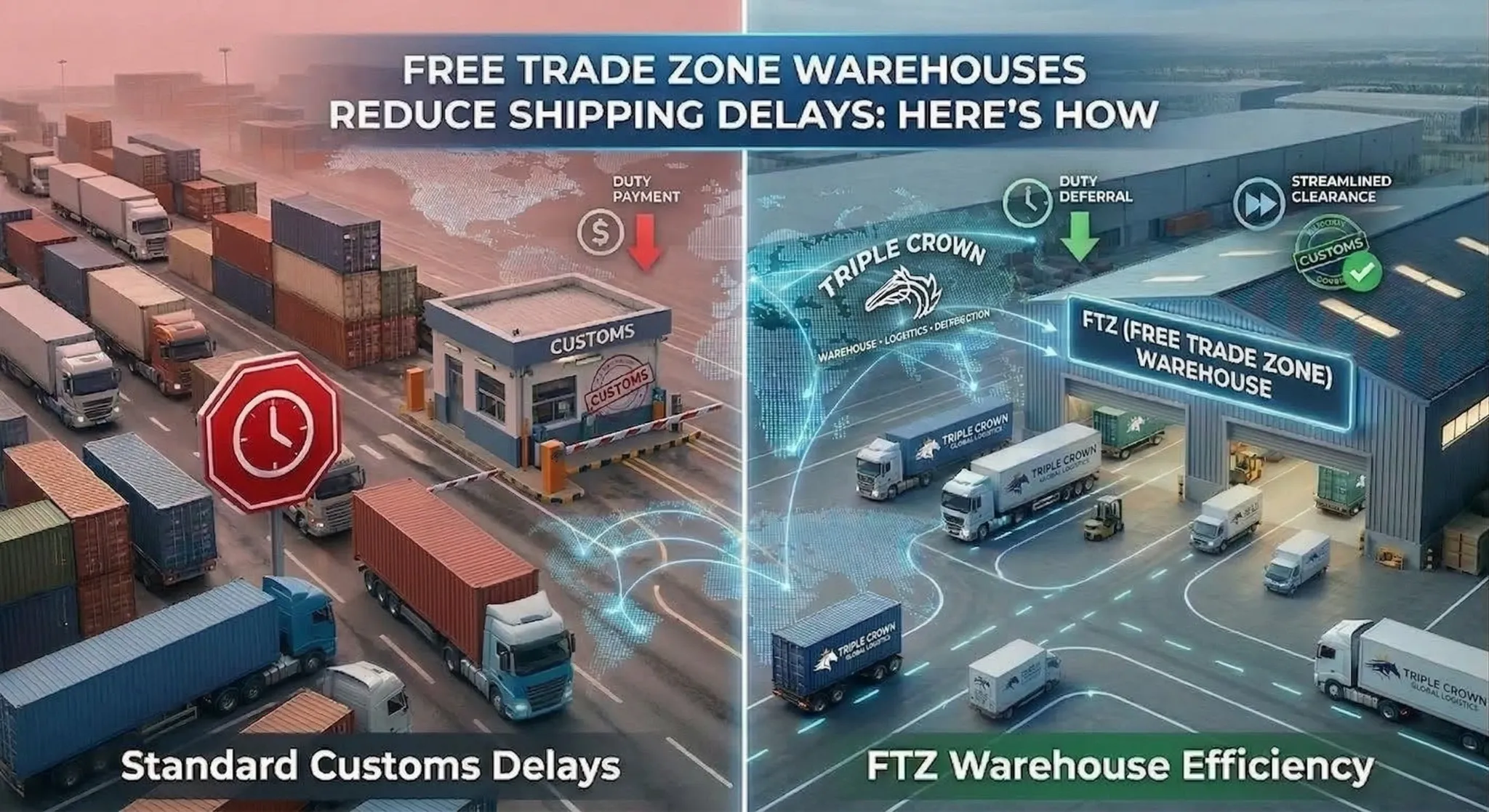
Unlike traditional warehouses, FTZ warehousing facilities allow you to store foreign goods without paying customs duties immediately. This unique capability creates opportunities to restructure your supply chain for maximum efficiency and minimum cost.
The key is viewing your FTZ warehouse not as a standalone facility, but as an integrated component that connects your international suppliers with your domestic distribution network.
Assessing Your Current Supply Chain for FTZ Integration
Before integrating a free trade zone warehouse, evaluate your existing supply chain to identify the best opportunities for optimization.
Start by analyzing these key areas:
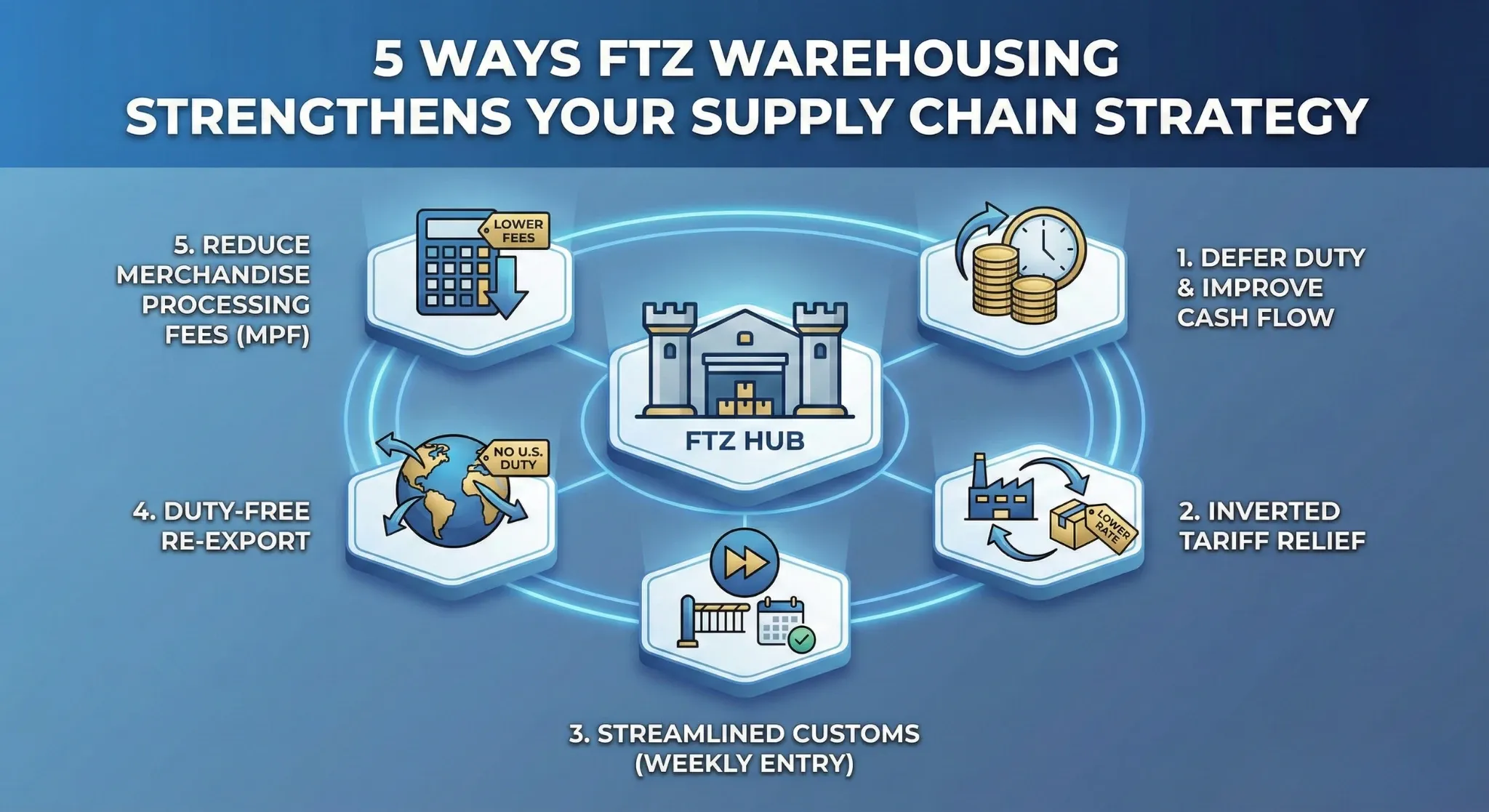
Import volume and frequency: How much product are you bringing into the country each month? Higher volumes typically benefit more from FTZ integration. If you’re importing significant quantities regularly, duty deferral can free up substantial working capital.
Product types and duty rates: Review the Harmonized Tariff Schedule for your products. Items with high duty rates offer the greatest savings potential. Products that undergo processing or assembly may qualify for inverted tariff benefits, where the finished good has a lower duty rate than components.
Current inventory patterns: Look at how long products sit in your warehouse before sale. Longer dwell times mean greater duty deferral benefits. According to the U.S. Customs and Border Protection, companies can defer duties for months or even years on inventory stored in FTZ facilities.
Distribution geography: Where are your end customers located? Strategic FTZ placement near major markets or transportation hubs reduces outbound shipping costs while maintaining duty benefits.
Export activity: Do you re-export any products? Items stored in an FTZ and then exported never incur U.S. customs duties, creating significant savings for companies with international customer bases.
Building Your FTZ Integration Strategy
Once you understand your supply chain dynamics, you can develop a comprehensive integration strategy.
Step 1: Map Your Ideal Product Flow
Design the optimal path for products from international suppliers through your FTZ warehouse to end customers.
Consider these flow options:
Direct-to-FTZ model: Goods ship directly from overseas suppliers to your FTZ warehouse, where they’re stored duty-free until needed. This works well for predictable, steady demand.
Hub-and-spoke approach: Use the FTZ as a central hub receiving bulk shipments, then distribute smaller quantities to regional facilities as needed. This reduces total transportation costs while maintaining FTZ benefits on stored inventory.
Just-in-time FTZ integration: Coordinate supplier shipments to arrive at your FTZ warehouse just before customer orders, minimizing storage time and maximizing cash flow benefits.
The National Association of Foreign-Trade Zones provides case studies showing how different industries structure their FTZ product flows for maximum benefit.
Step 2: Align FTZ Operations with Inventory Management
Your inventory management system needs to account for FTZ-specific considerations.
Implement these practices:
Duty status tracking: Maintain clear records of which inventory is in duty-deferred status versus duty-paid. Modern warehouse management systems can automate this tracking.
FIFO optimization: First-in, first-out inventory rotation takes on new significance in FTZ operations. Rotating inventory efficiently maximizes the duration of duty deferral.
Strategic admission planning: Plan which goods to admit into U.S. commerce (triggering duty payment) based on confirmed sales rather than speculation. This ensures you only pay duties on products you’re actually selling.
Waste and scrap management: Products damaged or scrapped while in FTZ status never incur duties, reducing the financial impact of inventory losses.
As detailed in our article on FTZ warehousing benefits and duty deferral, proper inventory management in an FTZ can deliver substantial cost savings beyond basic duty deferral.
Step 3: Integrate Value-Added Services
Free trade zone warehouses enable various value-added activities that can streamline your supply chain and reduce costs elsewhere.
Common value-added services include:
Labeling and repackaging: Customize products for different markets or customers without paying duties on the original packaging or components you remove.
Quality inspections: Identify and address defects while goods are still in duty-deferred status, avoiding duties on rejected merchandise.
Kitting and assembly: Combine components into finished products. If the finished good has a lower duty rate than the sum of component rates (inverted tariff), you pay less overall.
Product testing and compliance: Verify products meet regulatory requirements before admitting them to U.S. commerce, preventing costly compliance issues.
By centralizing these activities at your FTZ warehouse, you eliminate the need for separate processing facilities and reduce handling costs. For a complete list of services that can be performed in an FTZ, check out our services page.
Step 4: Coordinate with Your Transportation Network
Your free trade zone warehouse should integrate seamlessly with both inbound and outbound transportation.
Inbound coordination: Work with your freight forwarders and carriers to route shipments directly to the FTZ facility. This eliminates unnecessary transloading and reduces the risk of delays that could trigger demurrage charges.
Port proximity optimization: For East Coast importers, FTZ warehousing near major New York ports minimizes drayage costs and speeds up the receiving process.
Outbound distribution: Plan your distribution routes to maximize efficiency. Some companies use their FTZ warehouse as the sole distribution point, while others transfer goods to regional facilities for final delivery.
Cross-docking capabilities: For certain products, you might receive goods at your FTZ warehouse and immediately transfer them to outbound carriers without extended storage, still capturing duty deferral benefits on the transaction.
Overcoming Common Integration Challenges
Even well-planned FTZ integrations encounter obstacles. Being prepared for these challenges helps you address them quickly.
Challenge 1: System Integration Complexity
Your FTZ warehouse management system must communicate with your ERP, accounting software, and other business systems.
Solution: Choose an FTZ operator with modern technology infrastructure and proven integration capabilities. Request demonstrations of their API connectivity and data exchange protocols before committing. Ensure real-time data synchronization to maintain accurate inventory visibility across all systems.
Challenge 2: Compliance and Documentation
FTZ operations involve additional paperwork and regulatory compliance compared to standard warehousing.
Solution: Partner with an experienced FTZ operator who handles CBP compliance on your behalf. Their expertise reduces your administrative burden and minimizes the risk of costly violations. According to Foreign-Trade Zones Resource Center, working with knowledgeable FTZ operators is crucial for maintaining compliance.
Challenge 3: Staff Training and Change Management
Your team needs to understand how FTZ operations differ from traditional warehousing.
Solution: Invest in comprehensive training for logistics, finance, and operations staff. Your FTZ warehouse partner should provide initial training and ongoing support. Create clear standard operating procedures that outline how to handle FTZ-specific scenarios.
Challenge 4: Forecasting and Planning
Maximizing FTZ benefits requires accurate demand forecasting to optimize when goods are admitted to commerce.
Solution: Implement robust forecasting tools that consider sales patterns, seasonality, and market trends. Use this data to time customs entries strategically, paying duties only when products are ready to ship to customers.
Measuring the Success of Your FTZ Integration
Track specific metrics to ensure your FTZ warehouse delivers expected benefits.
Key performance indicators to monitor:
Duty deferral value: Calculate the average time between goods arriving at your FTZ and duty payment. Multiply this by your average inventory value and applicable duty rates to quantify cash flow benefits.
Duty elimination savings: Track the value of goods that are exported, damaged, or scrapped while in FTZ status, never incurring U.S. duties.
Inventory carrying costs: Compare your total inventory holding costs before and after FTZ integration. Factor in the reduced capital tied up in duty payments.
Order fulfillment speed: Measure whether FTZ integration improved your ability to quickly fulfill customer orders.
Total landed cost reduction: Calculate the comprehensive impact on your cost per unit delivered to customers, including duty savings, reduced inventory costs, and improved logistics efficiency.
Compliance accuracy: Monitor customs filing accuracy and any CBP inquiries or audits. A well-run FTZ operation should maintain near-perfect compliance.
Advanced FTZ Integration Strategies
Once you’ve mastered basic FTZ integration, consider these advanced approaches:
Market Testing with Reduced Risk
Use your free trade zone warehouse to test new products or markets with minimal financial exposure. Store inventory in duty-deferred status while you assess market demand. If products don’t sell, re-export them duty-free without paying U.S. customs duties.
Manufacturing and Processing Integration
If your business involves product assembly or manufacturing, integrating these activities into your FTZ warehouse can yield substantial benefits through inverted tariff structures, where finished products are taxed at lower rates than individual components.
Multi-Channel Distribution Optimization
E-commerce and retail businesses can use FTZ warehouses to efficiently serve both domestic and international customers. Products sold internationally ship directly from the FTZ without duties, while domestic sales trigger duty payment only upon final sale.
Creating a Long-Term FTZ Partnership
The most successful FTZ integrations involve true partnerships between importers and their warehouse operators.
Foster this relationship by:
Conducting regular business reviews: Meet quarterly with your FTZ warehouse team to review performance, discuss challenges, and identify optimization opportunities.
Sharing forecasts and plans: Give your FTZ partner visibility into upcoming changes in your business—new product launches, seasonal peaks, promotional activities—so they can prepare accordingly.
Collaborating on continuous improvement: Work together to streamline processes, reduce costs, and improve service levels over time.
Providing feedback: Share both positive feedback and constructive criticism to help your FTZ partner better serve your needs.
Taking the Next Step
Integrating a free trade zone warehouse into your supply chain strategy isn’t a one-time project—it’s an ongoing process of optimization and refinement.
Start with a clear understanding of your current supply chain, identify specific opportunities where FTZ integration delivers value, and implement changes systematically. Monitor results closely and adjust your approach based on what works best for your unique business situation.
The companies that benefit most from FTZ integration are those that view it as a strategic initiative deserving executive attention and cross-functional collaboration, not just a warehousing decision left to the logistics department.
If you’re ready to explore how integrating a free trade zone warehouse can transform your supply chain, contact our team at (631) 348-4994 to discuss your specific needs. Our FTZ experts can help you develop an integration strategy tailored to your business goals, ensuring you capture every available benefit.
About Triple Crown Warehouse: We specialize in helping importers successfully integrate FTZ warehousing into their supply chain strategies. Our experienced team provides the guidance, technology, and services you need to maximize duty savings and operational efficiency.