Shipping delays are one of the most frustrating and costly problems in international trade. A single bottleneck at customs can hold up an entire shipment for days, throw off your inventory schedule, and leave your customers waiting. If you’re an importer dealing with this regularly, the problem likely isn’t your carrier. It’s where and how your goods are being processed when they arrive in the U.S.
A free trade zone warehouse solves several of the root causes of shipping delays that standard import processes simply can’t address. This post breaks down exactly how FTZ warehousing speeds up your supply chain and what to look for in a facility that can deliver those results.
What Is a Free Trade Zone Warehouse?
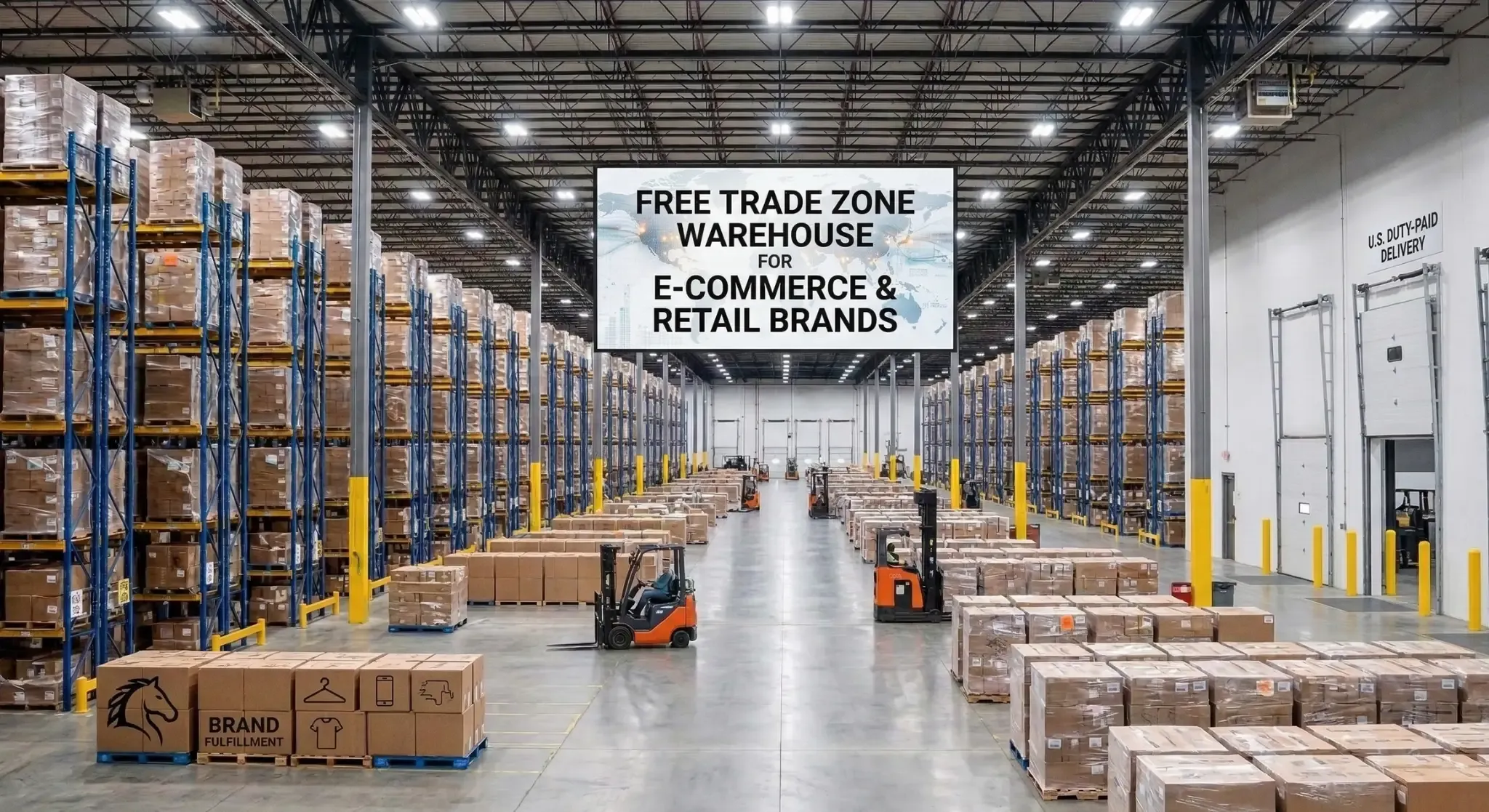
A free trade zone (FTZ) is a federally designated area within the United States that operates outside normal U.S. customs territory. Goods that enter a foreign trade zone warehouse are not subject to standard customs entry procedures right away. That means they can be stored, repackaged, inspected, or processed without triggering the usual documentation requirements and duty payments that slow things down at the border.
The U.S. Customs and Border Protection (CBP) oversees FTZ operations nationwide. There are currently more than 260 active FTZ sites across the country, many positioned near major seaports, airports, and freight corridors, specifically to support faster movement of imported goods.
At Triple Crown Warehouse, our FTZ-compliant facility in Hauppauge, New York is strategically located near the Port of New York and New Jersey, one of the busiest import gateways on the East Coast. That location alone puts us in a position to cut meaningful time out of your supply chain.
Why Shipping Delays Happen and Where FTZ Fits In
Most shipping delays at the U.S. border happen for one of a few reasons:
- Customs entries filed incorrectly or late
- Multiple entries required for multiple shipments
- Goods held for inspection before clearance
- High volume of filings creating backlogs at ports of entry
- Duties owed before goods can be released
Each of these points is a place where ftz warehousing creates a structural advantage over standard import procedures. Here’s how.
1. Direct Delivery Moves Goods Faster From Port to Warehouse
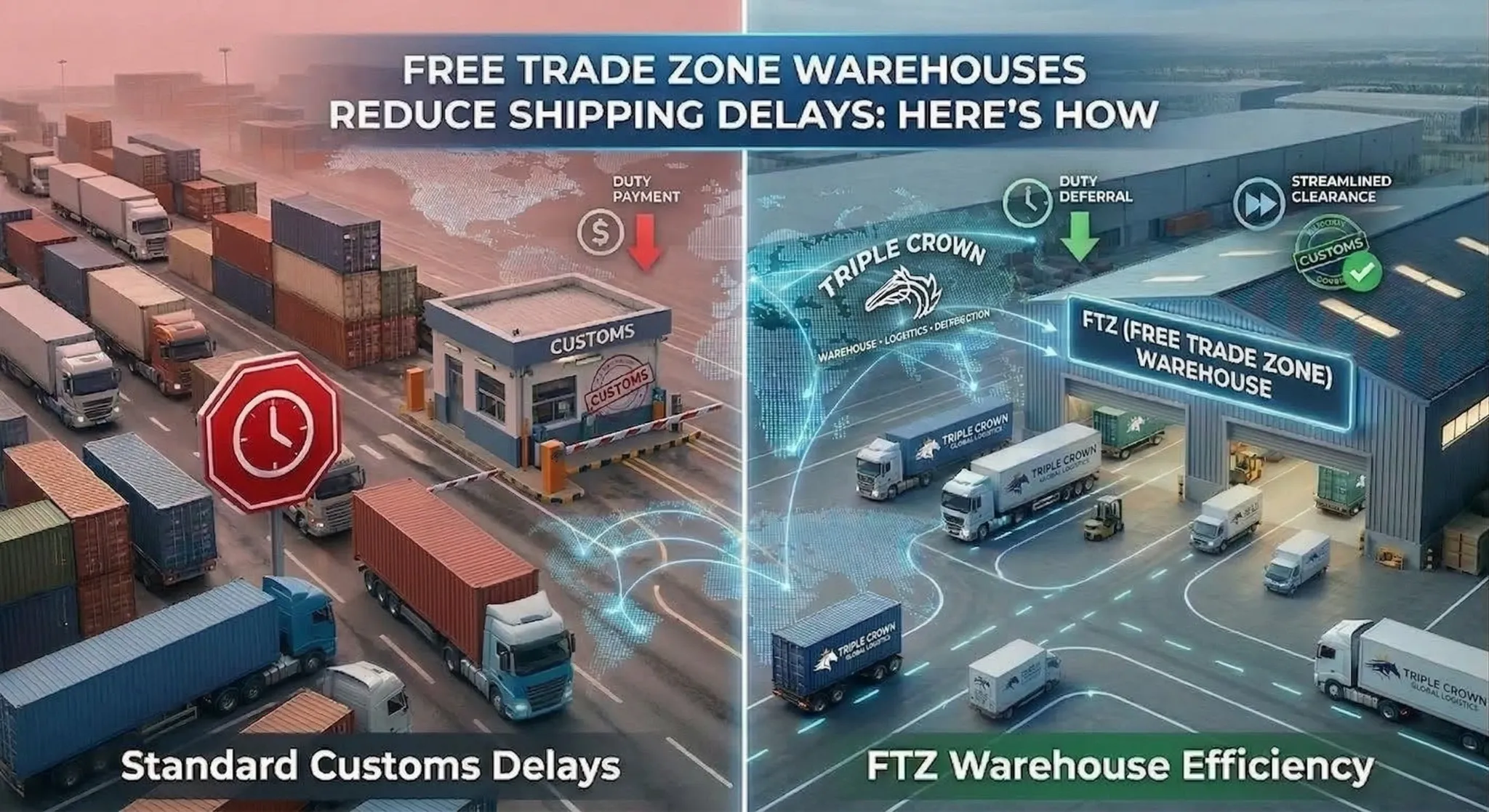
One of the most immediate time-saving benefits of a foreign trade zone is something called direct delivery. Under this provision, shipments can move directly from the port to the FTZ facility without waiting for a formal CBP inspection at the border.
In a standard import scenario, goods often sit at the port waiting for a customs entry to be processed and approved before they can be moved. That wait, even a day or two, can cascade into larger delays when you’re managing multiple shipments or tight inventory windows.
With direct delivery authorization, your goods move from ship to warehouse without that hold. The formal customs process still happens, but it doesn’t have to happen before your goods can be physically relocated. This alone can shave several days off your delivery timeline, particularly during high-traffic periods at major ports.
2. Weekly Entry Consolidation Cuts Customs Paperwork and Processing Time
Every formal customs entry filed with CBP takes time, both to prepare and to process. If you’re receiving multiple shipments per week, that means multiple entries, multiple broker fees, and multiple opportunities for a filing error to cause a delay.
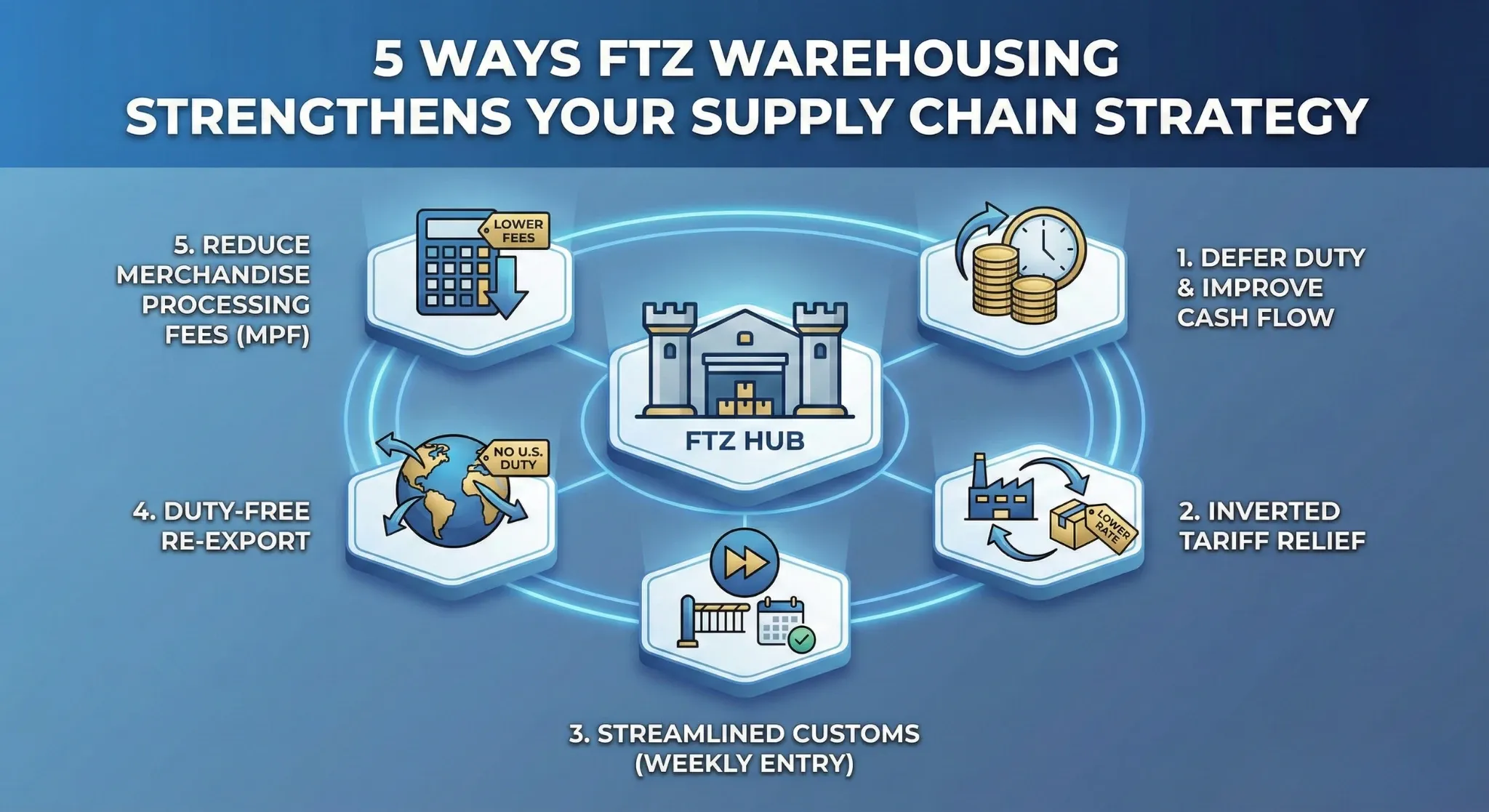
FTZ operators are permitted to use weekly entry, which consolidates all shipments admitted into the zone during a given week into a single customs filing. Instead of five separate entries for five shipments, you file one. That’s fewer documents in the CBP queue, fewer chances for errors, and a faster overall clearance process.
As the National Association of Foreign-Trade Zones (NAFTZ) notes, weekly entry is one of the core operational advantages that sets FTZ warehousing apart from standard bonded warehouse arrangements. For high-volume importers, the time savings from reduced filings can be substantial week over week.
Learn more about how this and other FTZ mechanisms reduce costs at our resource page on how FTZ warehousing cuts costs for importers in New York.
3. Streamlined Returns and Rejected Merchandise
Returns and rejected goods are a hidden source of supply chain delays that many importers don’t account for. In a standard customs environment, merchandise that is rejected, damaged, or needs to be re-inspected must go through formal customs procedures before it can re-enter storage, adding days or even weeks to the resolution process.
Inside a foreign trade zone warehouse, returns and rejected merchandise can re-enter the zone without triggering a new formal customs entry. The goods are already in a customs-controlled environment, so they can be inspected, repaired, repackaged, or redirected without the same procedural overhead.
For businesses that deal with quality control issues, product returns from domestic customers, or merchandise that arrives damaged, this means faster resolution and less time spent waiting on customs clearance for goods that were never properly entered into commerce in the first place.
4. Predictable Customs Protocols Mean Fewer Unexpected Holds
One of the less talked-about delay drivers in international shipping is simply unpredictability. When customs processes are inconsistent across different brokers, filing formats, and interpretations of entry requirements, you get unexpected holds, requests for additional documentation, and goods sitting idle while issues get sorted out.
FTZ facilities operate under clearly defined CBP-approved protocols. The relationship between an authorized FTZ operator and U.S. Customs is structured and ongoing, not a fresh interaction with every shipment. At a well-run crown warehouse like Triple Crown, our team works with established CBP procedures and documented inventory control systems, which means your shipments move through a predictable process rather than an unpredictable one.
Prologis, one of the largest industrial real estate companies in the world, notes that FTZ warehouses allow goods to be inspected, repaired, and repacked within the facility, and these processes are approved in advance by CBP, removing the ad-hoc delays that can plague standard import handling.
That pre-approved structure is a meaningful advantage when speed and reliability matter.
5. Inventory Flexibility Prevents Bottlenecks Before They Start
Many shipping delays aren’t caused by what happens at the border. They’re caused by what happens before your goods even arrive. If your warehouse is full, your receiving schedule is backed up, or you’re waiting on duty payments before you can take possession of a shipment, congestion builds at the port end of your supply chain.
FTZ warehousing gives you far more flexibility to manage inventory timing. Because duties aren’t owed until goods leave the zone and enter U.S. commerce, you can receive and store goods on your operational schedule rather than your payment schedule. You’re not forced to rush goods into distribution just to avoid accruing duty obligations on idle inventory.
This flexibility also helps with seasonal businesses. An importer receiving large volumes ahead of peak season can hold goods in the zone without rushing them through customs, then release them in batches as demand requires. The result is a smoother, more controlled flow of inventory with far less congestion-related delay.
FTZ Warehousing vs. Standard Bonded Warehouses: A Key Distinction
Many importers are familiar with bonded warehouses as a way to defer duty payments, so it’s worth clarifying the key operational difference when it comes to speed.
Bonded warehouses do allow duty deferral, but they come with stricter limitations on what you can do with goods while they’re stored. Goods generally cannot be manufactured, substantially transformed, or in some cases even meaningfully repackaged inside a bonded warehouse. That limits your options when a shipment needs handling before it’s ready for distribution.
Inside an FTZ, goods can be inspected, repaired, repackaged, relabeled, assembled, or even manufactured, all without triggering duty obligations. That operational flexibility means your goods can be ready to ship when they leave the zone, rather than requiring additional handling steps downstream. That same advantage is why FTZ warehousing is becoming a go-to strategy for brands that need faster, more flexible fulfillment. Learn more in our guide on free trade zone warehousing for e-commerce and retail brands.
What to Look for in a Free Trade Zone Warehouse
Not all FTZ facilities are equal. When evaluating a foreign trade zone warehouse for your supply chain, look for:
Location relative to ports. The closer the facility is to a major port of entry, the more you benefit from direct delivery and reduced transit time. Triple Crown Warehouse’s Hauppauge, NY location puts East Coast importers within close reach of the Port of New York and New Jersey.
Established CBP relationships. An operator with a history of FTZ compliance and an existing working relationship with CBP will process your shipments more predictably than a facility that’s new to FTZ operations.
Integrated distribution capabilities. An FTZ facility that also offers trucking and final-mile delivery, like the full range of services at Triple Crown Warehouse, means fewer handoffs between providers and less risk of delay at the distribution stage.
Inventory management systems. FTZ compliance requires accurate, real-time inventory tracking. A facility with strong systems in place keeps your CBP reporting clean and reduces the chance of holds or audits.
Conclusion
Shipping delays are rarely random. They happen at specific, predictable points in the customs and warehousing process, and a foreign trade zone warehouse is specifically designed to address most of them. Direct delivery, weekly entry consolidation, pre-approved handling protocols, streamlined returns, and inventory flexibility all work together to move your goods faster from port to market.
If your current import process leaves you regularly waiting on customs clearance, dealing with paperwork backlogs, or scrambling to manage inventory timing, ftz warehousing is worth a serious look.
Triple Crown Warehouse has been a trusted logistics partner in the New York area for over 35 years. Our FTZ-compliant facility in Hauppauge, NY is built to help importers move faster, pay less in duties, and operate with greater confidence. Call us at (631) 348-4994 or explore our FTZ Warehousing & Distribution services to find out how we can strengthen your supply chain.