Growing a logistics operation means constantly looking for ways to reduce costs, improve efficiency, and stay competitive. If you’re scaling your import business, you’ve probably explored various strategies to optimize your supply chain. One often-overlooked solution that delivers substantial benefits is partnering with an FTZ warehouse.
For businesses experiencing growth, understanding what is a FTZ and how it fits into supply chain planning and optimization can unlock significant advantages. This comprehensive guide explores the specific benefits free trade zone warehouses offer to expanding logistics operations.
What Is a FTZ? Understanding the Basics
Before diving into the benefits, let’s clarify what is a FTZ and how it differs from standard warehousing.
A Foreign-Trade Zone (FTZ) is a designated area within the United States where foreign and domestic goods are considered to be in international commerce. An FTZ warehouse operates within these zones, allowing businesses to store, handle, process, and manufacture goods without immediately paying U.S. customs duties.
According to the U.S. Customs and Border Protection, there are nearly 200 active FTZ projects across the country, serving thousands of companies in virtually every industry.
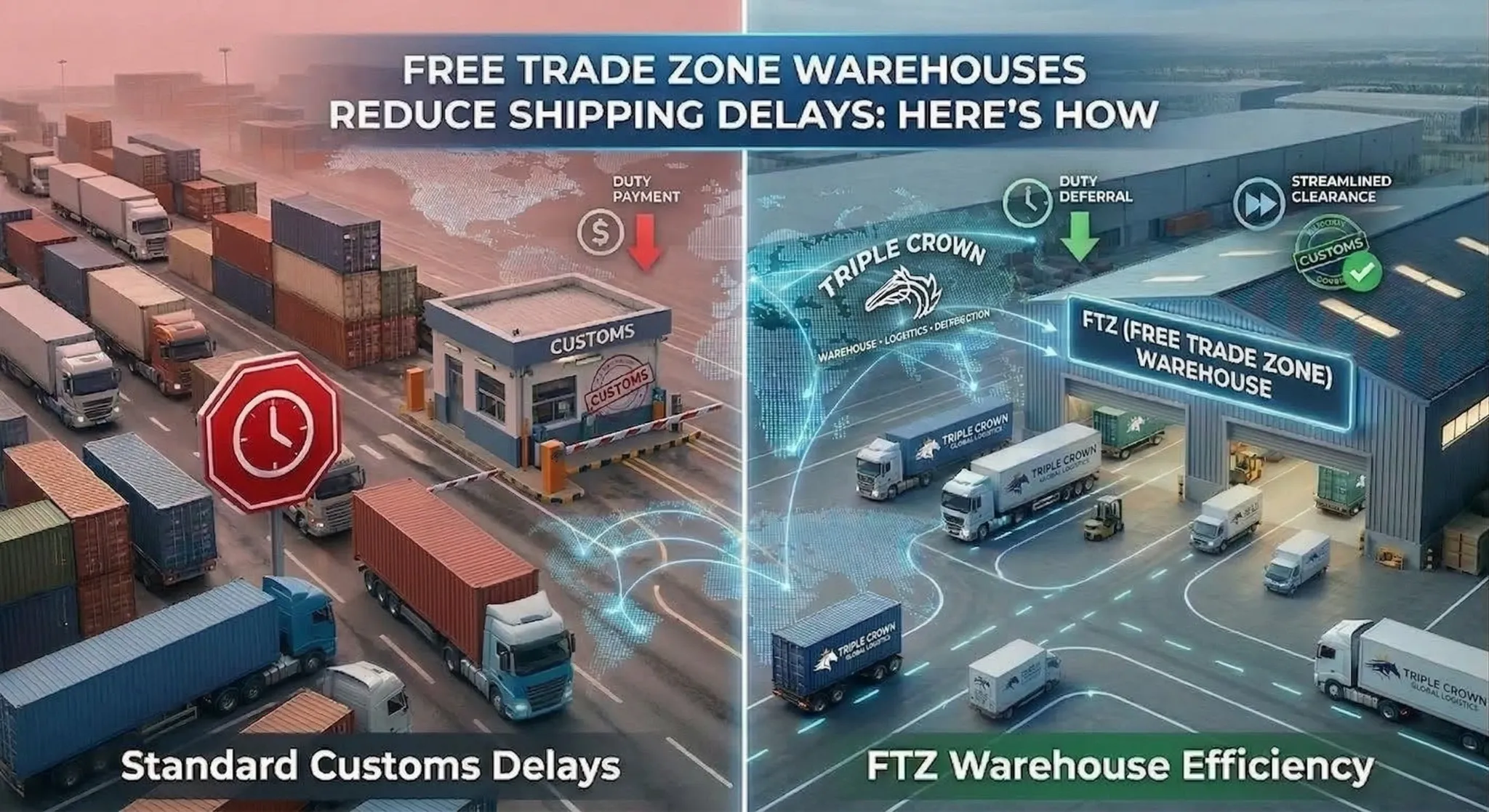
The key difference between an FTZ warehouse and a traditional warehouse is the customs status of the goods. In a standard warehouse, imported goods have already cleared customs and duties have been paid. In an FTZ warehouse, goods remain in a duty-deferred status until they enter U.S. commerce, are exported, or are consumed in manufacturing.
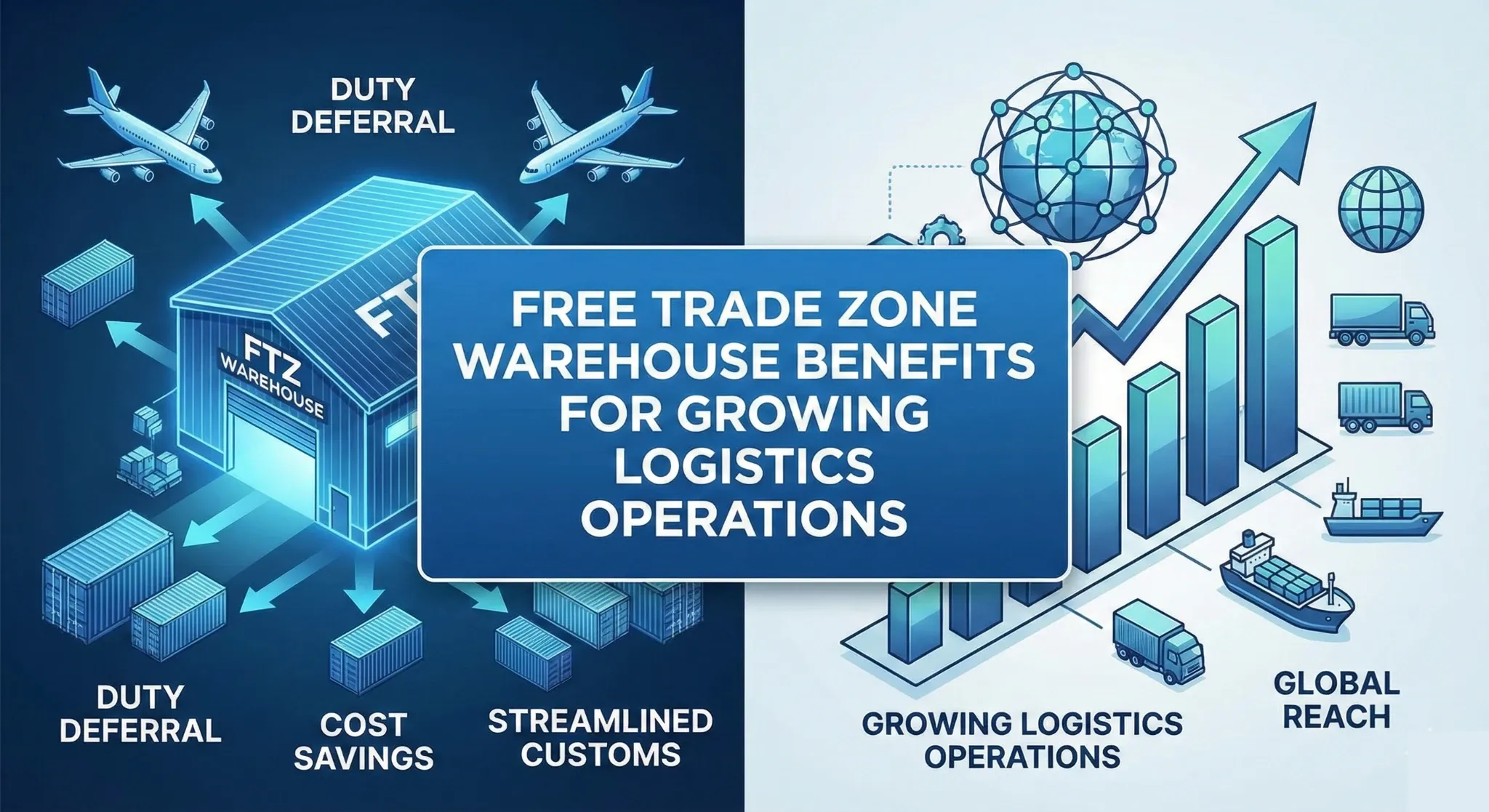
This fundamental difference creates numerous opportunities for cost savings and operational flexibility—especially valuable for growing businesses that need to maximize every dollar.
Why Growing Logistics Operations Benefit Most from FTZ Warehouses
Expanding businesses face unique challenges that make FTZ warehouses particularly advantageous:
Scaling inventory levels: As you grow, you’re carrying more inventory. The duty deferral benefits of an FTZ warehouse become more significant as inventory values increase.
Managing cash flow during growth: Expansion requires capital. Deferring duty payments frees up cash that can be invested in growth initiatives, marketing, or new product development rather than tied up in customs payments.
Testing new markets and products: Growth often involves entering new markets or launching new product lines. FTZ warehouses reduce the financial risk of these ventures by eliminating duties on products that don’t sell and need to be re-exported.
Increasing supply chain complexity: More products, more suppliers, and more distribution channels mean your supply chain planning and optimization becomes increasingly important. FTZ warehouses provide the flexibility to manage this complexity efficiently.
Major Benefits of FTZ Warehouses for Expanding Operations
1. Substantial Duty Deferral Savings
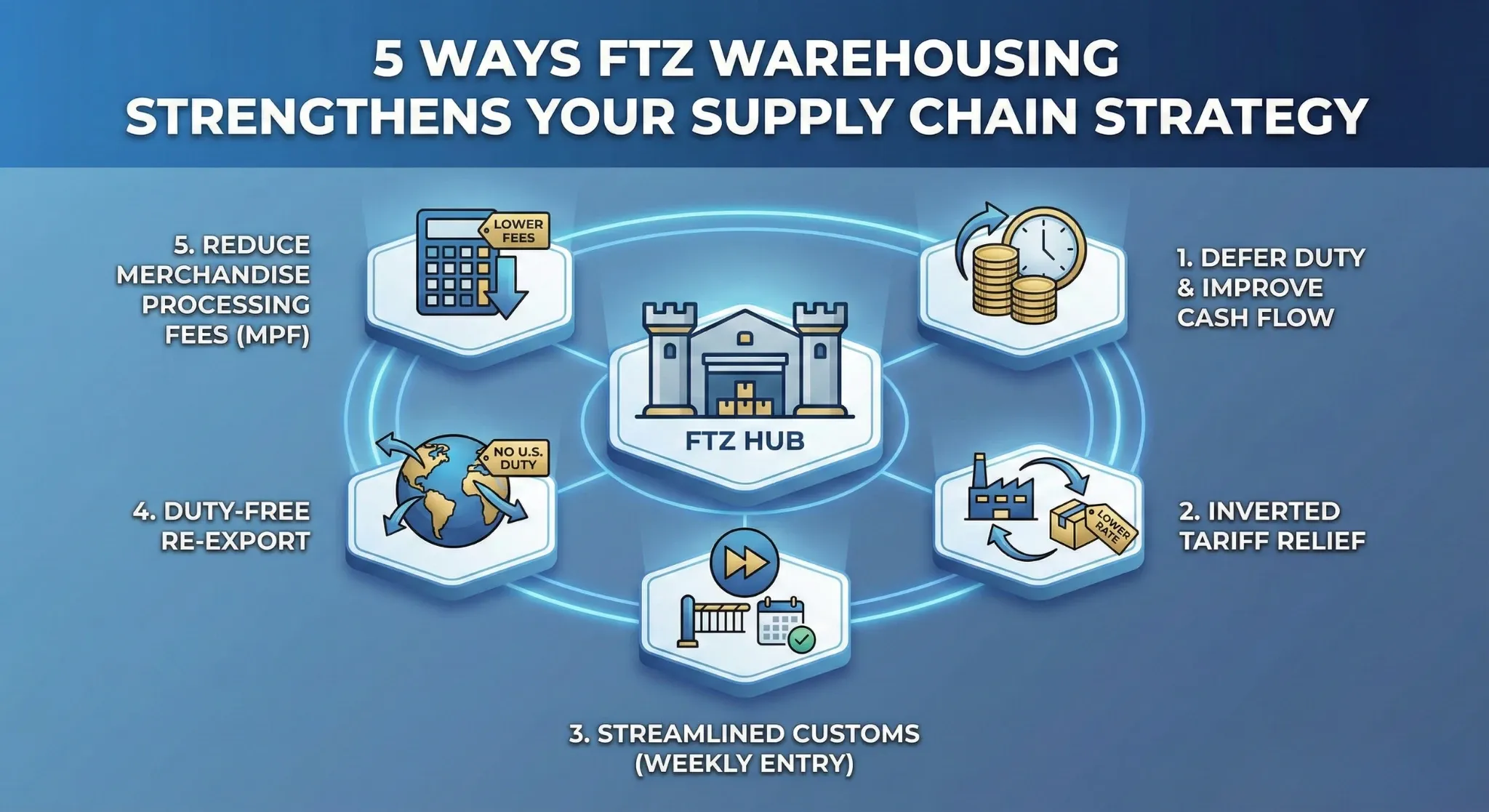
The most immediate benefit of an FTZ warehouse is duty deferral—postponing customs duty payments until goods actually enter the U.S. market.
For a growing business importing $1 million worth of goods monthly with an average 5% duty rate, that’s $50,000 in duties each month. In a traditional warehouse, you pay this upfront. In an FTZ warehouse, you only pay as goods are sold.
If your average inventory turn is 60 days, you’re keeping an extra $100,000 in working capital available at any given time. As your import volumes grow to $2 million or $5 million monthly, these savings scale proportionally.
This cash flow advantage is particularly crucial during growth phases when you need maximum financial flexibility. As detailed in our guide on FTZ warehousing benefits and duty deferral, these savings compound over time and can significantly impact your bottom line.
2. Duty Elimination on Re-Exports
Growing businesses often expand into international markets. An FTZ warehouse provides a significant advantage: goods stored in the FTZ and then exported never incur U.S. customs duties.
This means you can use a U.S.-based FTZ warehouse as a distribution hub for international customers without paying duties on those shipments. You only pay duties on goods that actually enter the U.S. domestic market.
For companies with both domestic and international customers, this creates substantial savings and simplifies inventory management by allowing you to serve both markets from a single facility.
3. Inverted Tariff Benefits
One of the most powerful but least understood benefits involves inverted tariffs—situations where the duty rate on finished products is lower than the duty rate on components.
For example, you might import electronic components with a 6% duty rate. If you assemble them into a finished product in your FTZ warehouse, and that finished product has only a 3% duty rate, you pay the lower rate on the higher-value finished goods.
According to the National Association of Foreign-Trade Zones, manufacturers and assemblers can achieve significant cost reductions through strategic use of inverted tariff opportunities.
This benefit particularly appeals to growing businesses that are adding assembly or light manufacturing capabilities to their operations.
4. Enhanced Supply Chain Planning and Optimization
Effective supply chain planning and optimization requires flexibility and control. FTZ warehouses provide both.
Flexible inventory positioning: You can import goods based on supplier production schedules and favorable shipping rates, then hold them duty-free until market demand dictates their release. This decouples your purchasing decisions from immediate sales needs.
Reduced forecasting pressure: Because duties aren’t paid until goods enter commerce, you can afford to carry more safety stock without the cash flow burden of prepaid duties. This reduces stockout risks during demand spikes—critical for growing businesses building their reputation on reliable fulfillment.
Streamlined multi-channel distribution: Whether you’re selling B2B, B2C, retail, or e-commerce, an FTZ warehouse lets you manage inventory for all channels efficiently. Goods remain in duty-deferred status until allocated to specific orders.
Better seasonal planning: Businesses with seasonal demand can build inventory during off-peak periods in the FTZ, deferring duties until the selling season begins and revenue is generated.
5. Risk Mitigation for Product Launches
Testing new products always involves risk. What if the product doesn’t sell as expected? In a traditional warehouse, you’ve already paid duties on that inventory.
In an FTZ warehouse, unsuccessful products can be re-exported or returned to suppliers without ever paying U.S. customs duties. This significantly reduces the financial risk of innovation and product expansion—essential capabilities for growing companies.
You can import test quantities, gauge market response, and make informed decisions about scaling up or discontinuing products without being locked into duty payments on inventory you can’t sell.
6. Duty Elimination on Waste, Scrap, and Damaged Goods
No operation is perfect. Products get damaged in transit, returned by customers in unsalable condition, or become obsolete. In a traditional warehouse, you’ve already paid duties on this inventory loss.
In an FTZ warehouse, goods damaged or scrapped while in duty-deferred status never incur duties. For growing operations handling increasing volumes, these losses add up. Eliminating duties on waste and damaged goods provides meaningful savings.
Some companies even use FTZ warehouses to conduct quality inspections immediately upon receipt, identifying and rejecting defective goods before any duties are incurred.
7. Streamlined Customs Compliance
As your import volumes grow, customs compliance becomes more complex and time-consuming. An experienced FTZ warehouse operator handles much of this burden for you.
They manage the paperwork, maintain compliance with CBP regulations, and ensure your operations meet all FTZ requirements. This lets your team focus on growth initiatives rather than customs documentation.
For businesses expanding into FTZ warehousing in competitive markets like New York, partnering with an operator who understands local regulations and port procedures is invaluable.
8. Value-Added Services Without Duty Impact
FTZ warehouses allow various value-added activities on goods in duty-deferred status:
Labeling and repackaging: Customize products for different markets or customers without paying duties on original packaging that’s removed or replaced.
Quality control and testing: Inspect, test, and validate products before admitting them to commerce, ensuring only quality goods trigger duty payments.
Kitting and bundling: Combine products into kits or promotional bundles without additional duty implications.
Assembly and light manufacturing: Transform components into finished goods, potentially benefiting from inverted tariff structures.
These capabilities support sophisticated supply chain planning and optimization strategies that give growing businesses competitive advantages.
9. Improved Financial Reporting and Planning
Duty deferral affects your financial statements in positive ways. Since duties aren’t paid until goods enter commerce, they align more closely with revenue recognition.
This matching of expenses with revenues provides a clearer picture of profitability and makes financial planning more accurate. For growing companies seeking investment or managing to tight budgets, this improved financial clarity is valuable.
Additionally, the predictable nature of duty payments (triggered by sales) makes cash flow forecasting easier compared to the variable timing of traditional duty payments (triggered by import shipments).
10. Scalability Without Proportional Cost Increases
Perhaps the most significant long-term benefit for growing operations is scalability. As your import volumes increase, the benefits of an FTZ warehouse scale proportionally while the administrative overhead remains relatively constant.
A business importing $500,000 monthly and one importing $5 million monthly both benefit from duty deferral, but the latter realizes ten times the cash flow advantage. Meanwhile, the complexity and administrative requirements don’t increase tenfold.
This scalability makes FTZ warehouses particularly attractive for companies with aggressive growth plans.
Strategic Implementation for Growing Businesses
To maximize FTZ warehouse benefits, growing operations should:
Start with high-duty products: Begin by moving products with the highest duty rates into your FTZ warehouse to immediately capture the most significant savings.
Integrate with existing systems: Ensure your FTZ warehouse’s technology integrates seamlessly with your ERP and inventory management systems for real-time visibility and control.
Plan for growth: Choose an FTZ warehouse partner with capacity to accommodate your expansion plans, avoiding disruptive facility changes as you scale.
Leverage value-added services: Take full advantage of services like quality control, repackaging, and assembly to streamline your overall operation beyond just warehousing.
Monitor key metrics: Track duty deferral value, inventory turn rates, and total landed costs to quantify the benefits and identify optimization opportunities.
Real-World Impact on Growing Operations
Consider a typical growth scenario: An e-commerce business importing consumer electronics grows from $2 million to $10 million in annual imports over three years.
Traditional warehouse scenario:
- Average duty rate: 4%
- Duties paid upfront: $80,000 in year one, scaling to $400,000 by year three
- Cash constantly tied up in prepaid duties as inventory grows
FTZ warehouse scenario:
- Same duty rate, but paid only on sold goods
- Average 45-day dwell time means $15,000-$50,000 in working capital freed up monthly
- Damaged goods and returns (estimate 2% of inventory) never incur duties: $1,600-$8,000 annual savings
- Ability to test new products with minimal risk encourages faster innovation
The FTZ warehouse provides both immediate cash flow benefits and strategic advantages that support faster, more confident growth.
According to the Foreign-Trade Zones Board, companies utilizing FTZ procedures report significant competitive advantages, with duty savings representing just one component of the total value.
Choosing the Right FTZ Warehouse Partner
For growing operations, selecting the right FTZ warehouse partner is critical. Look for:
Experience with growing businesses: Operators who understand the unique needs of scaling companies provide better support during your growth journey.
Flexible capacity: Ensure they can accommodate your projected growth without requiring facility changes that disrupt operations.
Comprehensive services: The best partners offer complete logistics services beyond basic storage, supporting your supply chain planning and optimization efforts.
Strong technology: Modern warehouse management systems with real-time reporting help you maintain control as operations grow more complex.
Strategic location: Proximity to ports, transportation hubs, and your key markets reduces costs and improves service levels.
Taking Advantage of FTZ Benefits
Understanding what is a FTZ and how it supports supply chain planning and optimization is just the first step. The real value comes from strategically implementing FTZ warehousing as a core component of your logistics operation.
For growing businesses, the combination of duty deferral, operational flexibility, and risk mitigation provided by FTZ warehouses creates a powerful platform for sustainable expansion. The cash flow benefits alone can fund additional growth initiatives, while the strategic advantages support faster, more confident entry into new markets and product categories.
As your logistics operation continues to scale, an FTZ warehouse partner that grows with you becomes an invaluable asset—not just a service provider, but a true partner in your success.
Ready to explore how FTZ warehouse benefits can accelerate your growing logistics operation? Contact our team at (631) 348-4994 to discuss your specific needs and discover how we can support your expansion goals.
About Triple Crown Warehouse: We specialize in providing FTZ warehousing solutions that grow with your business. Our flexible, technology-enabled approach helps expanding logistics operations maximize duty savings while maintaining the agility needed for rapid growth.